Categories
Article

La Marmotte 2009

Dave Kirton, with Ian Tyerman and Rob Carter 108 miles, Bourg d’Oisans, Col du Glandon, Col du Telegraphe, Col du Galibier, Bourg d’Oisans, Alpe d’Huez.

After ten months of talking about the Marmotte after visiting the Alps last September, it’s finally arrived. We have spent more time talking about it than the event will probably take. How hard will it be? What training do we need to do? What gears do we need? And so on! Rob has read the reports and apparently the Marmotte is supposedly one of the hardest sportives in Europe. However, myself and Ian disagree. We have both said it’s just long steady climbing whereas our local sportives such as the Rydale Rumble and Richmond 5 Dales have much more difficult steep climbs. Now the talking’s all over and its time to answer the questions.

Thursday 2nd July

We had a long day getting to Alpe d’Huez, after a two hour delay at Leeds Bradford airport and some difficulty sorting the car hire at Geneva. We finally hit the road at 7 pm for the two hour something drive to the Alpe. Ian is the designated bus driver and we make it to Bourg for about 9.30 pm. Thinking that all the food in the hotel will be gone we quickly grab a tasty pizza in Bourg before driving up Alpe d’Huez. It appears much steeper and longer than we remember as we drive up in the dark. We find the hotel Chimony and get checked in. It’s a good little hotel. Rob’s done well booking it, £121 each for 3 nights, breakfast and evening meal.

Friday 3rd July. The day before.
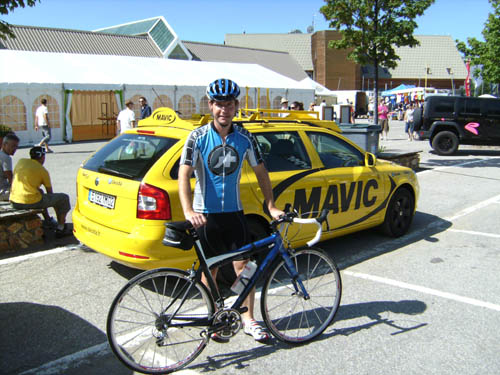
Have you got any massive sprockets?

After a tricky nights sleep I wake up about 7.30. Looking out the window there are great views of the mountains and a ski lift going past. We get breakfast and then start getting the bikes together. We have a spin around the top of Alpe d’Huez to check the bikes and descend a couple of hairpins and back up. We are not fancying going right to the bottom and back up again like some riders. It’s then off to register and get our numbers, timing chip and goody bags. There’s loads of stalls selling all sorts of cycling equipment. There’s also a free Mavic service van and Ian asks them to take a look at his freehub body. They whip it off, oil it, check it over and have it running smoothly in about two minutes.

We head in to the sports centre to register. Rob’s in the queue for rider numbers 501 to 2000. Myself and Ian are in the 2001 to 4000 queue. Then there is the 4001 to 7000 queue! It doesn’t actually take too long to get sorted. Whilst waiting we get talking to several cyclists who have ridden it before. They all say that the hardest part is hitting Alpe d’Huez after already doing 100 miles over three large mountains, well that’s no surprise. Apparently there is usually carnage on the Alpe with riders collapsing all over, with some people reportedly taking two to three hours to climb the final 13 k. Great, I just hope it’s not us!

After we get sorted with the bikes and registration we head to the car to do a full recon. This maybe isn’t a good idea as the general opinion is that things usually look much more difficult from the car. I hope this is true as the climbs and descents all look difficult from the car and it takes over four hours just to drive round. We take all the scenery photos on the way as we don’t plan to be stopping and taking snapshots on the event day. On the evening before judgment day we make our final bike and equipment checks. There is a good meal laid on for us at 8 pm. I think they know that they just needed to serve up loads of good pasta and all the cyclists will quickly hoover it all up. It must be said that the food and hospitality in the English-run hotel is top drawer. The staff are even going to get up early and do us all a breakfast at 5.30 in the morning.

Whilst we are eating our lasagne Rob spots a blob of ice cream on a dessert as it goes past. He begins to worry that eating it will affect his performance! This gives me and Ian much source of amusement as we imagine Rob being destroyed on the Galibier as the small blob of ice cream does its worst. He soon changes his mind when it’s served up in front of him with a slice of apple pie, it disappears down his throat in seconds!

We head back up to the room for an early night. We do a lot of talking before we can try and go to sleep. I have difficulty concentrating on my report writing as Ian has just come up with an amazing assessment of the ride. I think what he’s been on about for the last ten minutes is breaking the ride down in to individual sections of average speed to come up with an overall average speed of 12 mph which would get us round in nine hours, not including stops! Me and Rob are both looking at him in amazement. Rob’s also still discussing his nutrition strategy and there’s still a lot of other unanswered questions. What will it be like at the start with so many riders? What pace should we set on the Glandon? Do we stop at the first feed station for water? Have we got low enough gears? To be honest I think were all quite worried. After all the talk, not finishing the ride just isn’t an option!

Sat 4th July. Judgement day.

The big day arrives. After hardly sleeping at all the alarm goes at 5.15 am and it’s time to spring into action. Despite the poor night’s sleep I actually feel o.k. we get straight down for breakfast, there is porridge, cereals, fruit and croissants, I also get some tea and coffee down my neck. Rob takes a few anxious looks back over his shoulder at the breakfast bar to make sure he hasn’t missed anything. We get back up to the room, get our gear on, get the bikes out and like a military style operation we’re ready to roll down the Alpe in no time at all.

I have arm and leg warmers on and a rain cape to descend down the Alpe. Luckily the weather is really good and it isn’t too cold dropping down. But we do need to carry all the warm clothes. If it starts to rain on the Galibier in the afternoon things could turn very cold, very quickly. Hopefully this won’t be necessary but as Ian has said “prepare for the worst and hope for the best” we found this a really good way to think about this ride when we were preparing for it and deciding what equipment to take.

I really enjoy the descent down to Bourg and I am buzzing despite the early start. Already we have passed several riders that have punctured before they have even started. We get into Bourg and filter in to our different lanes. Basically this is how it works. The road is barriered off into two lanes which are then split into a further two lanes to filter the cyclists into the correct holding areas. There is 0 to 2000 of which the first 500 are the top riders. Rob is 746 as he got his entry in early. Then there’s 2001 to 4000 which myself and Ian go into. I am 2094 and Ian’s 2025. Then the last lane is 4001 to 7000! I think they closed entries at 7000.

Anyhow me and Ian filter into our holding area and wish Rob good luck as he heads to his. To be honest Rob is better off riding his own ride. He is much stronger than either myself or Ian now and he has recently gained his second cat racing licence after only being fully in to cycling for three years, and despite his denials he’s probably going to attack the course. Whereas me and Ian are going to treat it like we’re cycling to Castleton tea shop and back half a dozen times.

The time ticks by and at 7 am it’s time for the first 2000 to roll out. They gradually start squeezing out over the start line and by half seven it’s time for our 2001 – 4000 group to go. We squeeze out onto the high street, one foot in the pedal as we paddle along with the other foot on the floor. As we approach the start line we manage to get both feet in and ride over the start line. There is a start mat that you ride over which registers the electronic timer (dibber) around your ankle. These timing mats are placed at various key points on the course. As we roll out there are crowds cheering and a brass band playing “when the saints go marching in” it’s a great atmosphere and very well organised. We were warned about how crowded the roads would be over the first few miles, but as the riders spill out over the start line they spread out nicely as they are gradually released.

The Col du Glandon. 1924 m.

We’re off! It’s 7.35 and we’re both sailing off down the road. A slight downhill seven km to the right turn which takes us over the Glandon. It’s great, just like a giant spread out club run with cyclists for miles in front and behind. Some take it easy, others nail it down the outside to gain places. Me and Ian just go with the flow.

We turn right up towards the Glandon which is confusingly also called the Col de la Croix de Fer depending upon which way you go over the top. I ask Ian if he is ready for the first of four appointments with pain. At this point we are still laughing! We climb up the side of the dam that the tour came down a year or so ago. It’s then flat for a couple of k, then we hit the base of the Glandon.

We had ridden the Glandon the previous year so we knew that it was more difficult than the profile suggests. It ramps up steeply for several k before levelling out, then there is a short descent then it ramps up again, before steadily climbing past more scenic lakes and dams to the top.

We set a steady pace as planned, but I begin to get irritable as riders continually pass us. We could easily stick on another one mph, but Ian talks me down and convinces me that we need to stick to the plan if we are to have anything left at the end. I can also hear the voice of Phil Meadows in my other ear with his talk about how he used to break his endurance running down in to steady blocks, and this way he would eventually catch up and overtake the runners that had set off faster. So with me brought back into line I let Ian get on with his controlled pace setting.

The top of the Glandon arrives quite nicely after 2.04 of riding. We’re both wondering where Rob might be now and I suggest we should have fitted him with a Rob cam! It’s mayhem at the feed station at the top. We had planned not to stop but we need enough water to make the descent and the long valley road before the next feed station at St Michel de Maurienne. We descend off the Glandon down to Saint Alban des Villards. It seemed like it would be a difficult and dangerous descent when we went down in the car, but on the bikes we flow down easily. I would rate us as average descenders but we seem to flow past other riders easily, even though we’re riding cautiously. It’s a long technical descent down and takes about 30 minutes to reach the bottom and my wrists feel like snapping as we hit the speed ramps going into the town.

We press on along the supposedly flat road towards St Michel de Maurienne and the base of the Telegraphe. The road is really heavy and its now getting towards 11am, the temperature is getting up towards 30 deg C. At one point I indicate to Ian to pull over. I’m convinced that my back brake has jammed on, but it’s fine, it’s just the false flat and heavy road taking its toll. We settle in to a good group and make it to the next feed station at the bottom of the Telegraphe. There’s more mayhem at the feed station as we grab water and prepare for the ascent of the Telegraphe.

The Telegraphe. 1570 m.

Col du Telegraphe
Col du Telegraphe

The Col du Telegraphe is supposedly the easier of today’s four climbs. Just a warm up before the Galibier! We climb up steadily. Ian’s setting the pace again, but with the heat and the continuous gradient starting to take its toll the Telegraphe starts to sap our energy reserves. Anyhow we manage a good pace, doing the 12 k to the top in just under an hour. We seem to be starting to pass many riders on the way up that are beginning to have difficulty with the conditions. I take time to look over the edge at the sheer drops down to the town below. It’s like taking off in a slow aeroplane, then I get back to focusing on Ian’s pace setting. It’s interesting watching other people’s styles. Stronger riders pass us and disappear, others seem to repeatedly sprint past and then go back over which seems a waste of energy, whilst others simply go back over. The other funny thing I have noticed is that there’s no talking? It’s like a slow silent race. Everyone is in their own little world of concentration.

We reach the top at 1570 m. There’s another feed station and we top up with supplies again. There’s less mayhem this time. The Telegraphe has been a steady gradient over an hour but with the heat it’s started to take its toll on both of us. It’s a pleasant descent of 5 k to Valloire. Now it’s time for the biggey.

The Col du Galibier. 2642 m.

Dave on the Galibier wonders when it's going to start getting tough
Dave on the Galibier wonders when it’s going to start getting tough

As we climb out of Valloire the sign says Col du Galibier 17 k, great! Now this climb didn’t seem too steep when we went up in the car and we had cycled up from the Col du Lautaret side last year and it was o.k. but as we drag up, the length of the climb combined with the heat and 60 miles already in our legs starts to take its toll. We seem to be steadily passing riders again but as we hit the 10 k to go, we both start to get in to difficulty. Ian suggests I ride on by myself as he’s suffering, but after a couple more k I have to let Ian go as I suddenly begin to feel sick and my power is failing. I arrange to meet Ian off the descent at the other side of the Galibier, top of the Lautaret. With about 5 k to go I’m in real difficulty. My legs have gone and I feel like I just want to get off and throw up. Ian later tells me he felt the same on Alpe d’Huez and a lot of other riders are looking in similar condition. We believe it’s due to trying to get all the food and energy drink down in such heat. Anyhow I decide I’d rather plod on slowly than stop. I endure one of the most torturous 45 minutes on the bike ever as I creep up this massive mountain at 4.5 mph.

Even though I feel bad I try to take in the breathtaking scenery. There’s a thunder storm rumbling over the mountains behind, I just hope I make it over the top before it hits. As I look down to the valley below there’s still along line of cyclists all the way down. I’m just glad I’m not back down there. I try not to look up as there’s still several hairpins to go towering above me. There’s a continues stream of riders passing me. I’m really disappointed as it starts to look like my ride might be over. I have to pull on all my cycling experience and will power but eventually haul myself over the top. At the top I roll straight over and descend down to the Lautaret. Ian has been there about seven or eight minutes he says and hasn’t had the greatest time either. I get off the bike and go behind a car to be sick. Ian points out that there’s a family nearby trying to have a picnic. I hope I haven’t spoilt their dessert! Does this paint a lovely picture of the Galibier!

I thought at this point my ride was over and tell Ian to press on as I put my emergency recovery plan in to action. I have five minutes rest and stock up with a bottle of water and another of energy drink. Now the descent off the Lautaret is a long steady one for about 25 miles back to Bourg with just a few smaller rises towards the end. So I steadily descend down, constantly sipping water. I pass riders again on the steeper part of the descent and after a while I get on to the back of a good group and my stomach begins to settle down. I start to gradually load up with gels and flap jacks, nibbling continually until we reach Bourg. I even do some turns on the front as my power seems to miraculously come back on. Hopefully that’s my bad spell over. But what a fine place to have a bad spell on the mighty Galibier.

Alpe d’Huez. 1880 m.

Alpe d'Huez, hairpin 4
Alpe d’Huez, hairpin 4

I arrive at last at the base of Alpe d’Huez. Reports later said it was 38 deg C at the bottom. I feel o.k. now the engine room has switched the power back on. I get stocked up with two bottles of water at the feed station. My plan is to steadily spin up the Alpe and most importantly keep cool by pouring water over my head. I settle in to a reasonable pace keeping up 6 mph. The longest steepest section is from the bottom to the first hairpin 21, “where Sastre attacked last year” I get to there and start counting down. I’m passing riders again and just keep drinking the water then pouring some over my head which feels great. Lots of riders are stopping and cooling themselves in the waterfalls that come down the sides of the cliffs, other riders are getting off and lying down. I would rather just keep plodding on. I get extra water handed out by supporters at the side of the road and I pour most of it over my head.

I make good progress as the hairpins tick away and Bourg d’Oisans begins to look like a toy town below. I get to about 4 k to go and after my good spell my legs start to fail again as I have been climbing the Alpe for an hour. But look who’s ahead! There’s Ian at the side of the road. He’s off his bike and looking like he’s going to throw it over the edge. It’s Ian’s turn for a bad spell and he said he just had to get off for a minute as he has had enough of riding his bike. He climbs back on the bike and we both struggle the final 4 k to the top. It takes another 20 minutes or so to complete the final push to the top. Every pedal turn becomes more difficult. We pass many riders in much worse states or passed out at the side of the road. It’s Alpe d’Huez carnage in the heat. As the road levels off at the top the finish line looms into sight. We crawl over the finish line, it’s such a relief to finally stop pedalling. We both collapse on top of the bars and say never again! As we move through the finishing area there’s Rob looking fresh as a daisy. He shouts are you both alright, I reply we’re far from alright Rob. My legs start to lock up as I walk with my bike like John Wayne. Me and Ian have completed it in 9hrs 27 mins. Just 37 minutes outside the gold time of 8.50, so respectable I think. In fact Ian’s calculations of 12 mph were not far out as I register 12.2 mph average on my computer. But get this, Rob’s finished in 7 hrs 36 mins! We knew he would go well but didn’t think he would get round that fast. The winning time is 6.09 by a rider called Bart Dekker. But Rob’s finished number 335, up with the top riders. Rob takes our timers for us and exchanges them for certificates and Marmotte water bottles. That’s all you get for the efforts. No free T shirts and medals are ten euros. We get back on the bikes to ride the 500 m back to the hotel but I can’t actually do one more pedal revolution as the back of my legs have locked up. Back at the hotel I climb the three flights of stairs with great difficulty. We get showered off and collapse on the beds. It’s been a real long day!

Later on.

After an hour or so of recovery I persuade Ian and Rob that it would be good to take a walk out on to the Alpe to stretch our legs and watch the stragglers coming in. Some riders will take 12-13 hours to finish. There’s actually a cut off time of 6 pm at the bottom of the Alpe where they will take your timer off you which seems a bit cruel.

Its half six and there’s still a steady stream of riders making the last bend. We give them a big shout as they go past. We have a lot of respect for these riders. Anyone who has made it has done well. At this point a rider comes by and I have to look twice in amazement. We all can’t believe it, I’m not kidding he’s got one arm and one leg! We’re awe struck. Now that guy deserves a free medal. It must be hard enough on the climbs but imagine him on the descents! Back at the hotel we shove down our tea. But then our big drinking session we planned on Alpe d’Huez turns in to two small bottles of beer. That’s all we can manage as w’ere just too knackered.

That’s it, it’s all over. We pack the bikes the next morning and drive down the Alpe, stopping half way down to watch some of the riders that are time trialling up in an event called the Grimp. Most of these riders will have done the Marmotte yesterday. Some people really like their punishment! We drive away from the Alpe back to Geneva, and despite saying that I would never do it again we find ourselves already talking about how we could improve and the possibility of riding next year. Aren’t cyclists stupid!

After thoughts.

The Marmotte has been a spectacular event and very well organised. There were no problems at all with the number of riders at the start. And the instructions were all clear and easy to follow. The feed stations, although hectic, did very well to cope with the volume of riders. The route itself was spectacular if you took time to look around, but it was extremely challenging. The heat was a big factor, but equally it could have been really cold as in previous years. I’m just glad I did lots of long training rides for it otherwise that bad spell on the Galibier might have been the end of it. In answer to our earlier question, yes it is more difficult than our local sportives and I’m sure that it probably is one of the hardest in Europe. Although the climbs aren’t really steep it’s the sheer length of them. Out of the 9 hrs 27 min of riding I reckon that nearly six hours of it was climbing, or in terms of distance we’re looking at M’bro nearly to Scarborough uphill. Frightening if you think about it too much.

The only thing we did get wrong was the gearing. I had a compact on, 34/25 and Ian and Rob had 38/27s which is nearly as low. These gears were fine in the Alps last year over shorter distances. But we could all have done with a lower emergency gear. Lots off the real good riders that past us had what looked like 34/27s on. From what Rob was telling us the top riders nail it round much faster but then just stick it in to the 27 and spin up Alpe d’Huez. The annoying thing is that I have a new set of 12/27 Ultegra sprockets in the garage! But I decided not to put them on. What a dummy.

Well I think it’s been well worth the efforts. Now I’m going to do some armchair cycling in front of the TV for the rest of July watching the tour. Then I’m going to retire to Castleton tea shop all winter before one of us comes up with the next stupid idea!

Dave Kirton – July 2009
Categories
Article

The Man Machine

It seems that everyone is riding a bike these days. I read recently read that Alan Sugar has been seen on a £9,000 Pinarello equipped with the new 11 speed Campagnolo Super Record groupset, seriously I’m not pulling your leg! What with George Bush, David Cameron, Boris Johnson and even Philip Glenister (out of Ashes to Ashes and Life on Mars) taking to two wheels it seems cycling is finally catching on. I didn’t really know what to make of this though, after all cycling is cool and I’m not sure that Sir Alan and David Cameron will encourage people to pop a leg over a top tube and take up our beloved sport. For proper coolness we should be looking to the world of music.

For those who have been around for some time like me they may remember the German band Kraftwerk. Kraftwerk were the pioneers of electronic music, and arguably modern dance music, they were certainly cool, well at least cooler than Sir Alan Sugar. It is often said that cycling is the perfect combination of man and machine, both aesthetically and bio mechanically, I don’t know who often says this, me probably. Anyway I digress; Kraftwerk released an album called the Man Machine in the late 1970’s. It was often assumed that they were talking about men being consumed by technology and ultimately becoming mechanised. This may well have been true and their live performances at the time certainly suggested this as they pioneered electronic music and even replaced themselves with robot replicas on one tour. What they may have been talking about though was bikes. They later released a track called Tour De France which was used by Channel 4 for its coverage of the tour in the 1980’s. They even formed their own cycling club called Radsportgruppe Schneider and sometimes refused to give interviews to music journalists unless they agreed to talk only of cycling. Their obsession grew and grew and this eventually led to two of the band leaving as they were fed up with sitting around the music studio doing nothing while the others preferred to concentrate on riding the major climbs of the Tour and the Giro. It nearly ended in tragedy when founder member Ralf Hutter ended up in a coma after a pretty bad crash, his first words when he came round were famously ‘how’s my bike?’

As you may have guessed I have just read a book on Kraftwerk. The bits on cycling got me thinking about other bands and musicians who are cycling obsessives. Scottish Indie band the Delgados removed all doubt of their influences by releasing albums called Peleton and Domestiques. I also remember liking a band in the late 1990’s who were called Campag Velocet, when I went to see them live the singer was wearing a cycling top. Although impressed I did wonder about the dangers of naming yourself after a groupset, Shimano 105 or Campag Centaur really doesn’t work, although Campag Chorus clearly has potential in a musical sense. Other bands who also wore cycling attire were Carter the Unstoppable Sex Machine and the Age of Chance. The problem here is that they are relatively minor bands who most of you have never heard of, so I looked further. How about Duffy? In one of her recent videos she rides in on a retro single speed, possibly fixed, machine looking quite fantastic. Never looking fantastic, at least I don’t think so, is Mick Jagger. However credit where it’s due, Mick is a famous and long term cycling fan and rides a Condor apparently. Another notable mention goes to Sheryl Crow, who as well as going out with Lance became a keen cyclist while doing so, saying that neither Sheryl nor Mick let cycling influence their music, shame on them.

Sadly there are also two cycling rock deaths and both female at that, Mary Hansen who was guitarist and singer out of cult 90’s band Stereolab and Nico who sung with Lou Reed’s band the Velvet Underground both died as a result of cycling accidents.

I will end though with Jimmy Savile, not a pop star as such but a rather scary figure who hosted Top of the Pops as well as ‘fixing it’ for people during the 1980’s. Before he started to run marathons in gold lame suits he actually rode the Tour of Britain in 1951. As if this were not enough one website entry credits him with holding a roller racing record although it doesn’t go into any more detail, Bryan Bevis would certainly approve!

Paul Christon – May 2009

Categories
Article

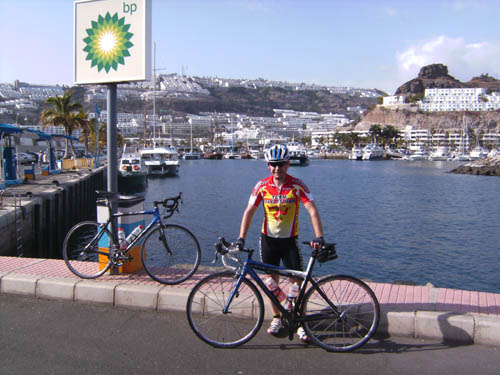
Gran Canaria 2009

Gran Canaria 2009- Dave Kirton & Rob Carter

Monday 16th March

After recovering from the disappointment of missing the Northallerton 50 in 4 again due to a family trip, Rob and I set off for Manchester Airport early doors! We arrived at the airport in good time, departures was a bit more hassle than usual. It appeared that the check in staff had not dealt with bike bags for some time and didn’t have a clue what to do or where to send the bikes! It cost £60 with Monarch Airlines, (ouch).

Whilst waiting in departures Rob says “Oh no” and puts his head in his hands. What had he forgotten? His pedals? His shoes? No, just the key for the 3 kg bike lock that’s weighing down his case. Roll on!

We arrived at Playa del Ingles ok. We got a taxi from the airport to the hotel, as there is often hassle on bus transfers with bike bags, 40 Euros. The hotel was ok, of course the first job was to put the bikes together, and then we went down to the restaurant for a nose bag! For anyone who doesn’t already know Playa del Ingles is apparently the gay capital of Europe. Rob brought it to my attention that we were surrounded by mostly German gay and lesbian couples, we were going to have to watch out, two straight cyclists with shaven legs, say NO more!!

Tuesday 17th March

The wrong turn
The wrong turn

We managed to get up reasonably early to get our breakfast; we were out on the bike by 10:00. We had a 55 mile route planned that we had read about on the internet on the Mike Cotty website.

It was straight uphill for the best part of 25 miles on the GC65, we settle into a steady pace about 10 mph, the tarmac was really smooth; it kicks up through some fantastic scenery and Spanish villages. There were some descents in the climb which also made it difficult as they destroy the rhythm.

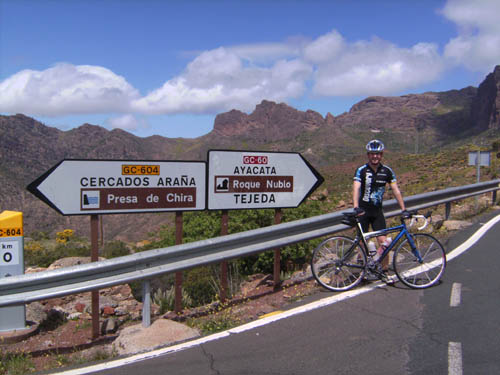
We reached Ayacata at about 1600 m. It was spectacular, about a two hour climb. There were loads of cyclists out, including some mountain bikers that were going quite quick and it took a while to distance them.

We decide to press on to the Pico Nieves, the highest point of the island at 1949 m. Unfortunately we miss the turn and end up descending five miles down the wrong side of the mountain towards Tejeda. We stopped to check the map then cycled all the way up again! I was sure Rob did this on purpose to make me suffer!

Once back at Ayacata we descended back down the GC605 and 505 to Arguinegun. The road was really rough in places but unbelievably steep and twisty, like a Castleton descent but longer. Once the road levels a bit it’s a hard slog into a headwind, we did some bit and bit and pass a couple of those free wheeling groups, these are the people who get a lift to the top then roll down! They’re not having it easy though and are having to pedal down hill in to the tough head wind. I wonder if they can have their money back? We go back over some rolling coastal hills on the GC500 back to the hotel. We did 68 miles, 14.2 mph average, 4:40 hours riding.

When back at the hotel we ask about moving rooms, we had no balcony and the room was too hot. The man was really helpful and offered us a room in another hotel near the sea. We packed up and moved on, the new hotel was great! Totally knackered now so time for some San Miguel rego on the balcony.

Wednesday 18th March

Amadores Beach, Puerto Rico

Today we rolled out west along the coast; the 20 km or so to Puerto Rico is more difficult than the mountains as it rolls up and down from sea level to 100 m or more. Just to make it more difficult we passed some very fast looking mountain bikers that latched onto our back wheels. We did intend to roll out steady but seeing as we had them in tow we had to put our foot down, they managed to stay with us! By the time we got half way along to Puerto Rico (GC500) the mountain bikers turned right, I was glad because I couldn’t keep up the show much longer!

As we climbed over the rolling coastline and then inland from Puerto Mogan to Mogan on the GC200 I started to pack up, it felt like a bad day. So we took it easy up to Mogan. The weather was looking tricky and it started to rain, it cooled me off though and I started to ride into it. We pass through Mogan and took a right on to the GC601 up a really long rough climb. It was amazing, the road zig zags up with steep hairpin after hairpin, it’s a wall of rock with only occasional glimpses above of where the road goes. After about 6 miles/50 minutes we reached the top in thick cloud. The rain started to get heavy, we had a quick chat with a German couple, they had been away for four days but it was their first ride because their bikes had been sent to Majorca by mistake, Unlucky!

We got our rain capes out and descend gingerly down the rain soaked mountain side. The rain really belted down as we headed back to the coast, “Rain in Gran Canaria, when it’s sunny at home! What is going on!”

On reaching Puerto Rico the rain stopped, we had a café stop, a little tour around then rolled back on the GC500 to Playa del Ingles, we took it a bit steadier than when we rode out.

Once we reached Playa del Ingles, we did about five miles spinning round the resort looking for an alleged bike shop, we didn’t find it but it did clock up a few extra miles whilst winding off. We arrived back at the hotel at 5 pm, it had been a long day out, 72 miles at 14.4 mph, it was a really big hill though, honest!

Thursday 19th March

No view at the summit

Today we planned to climb the Pico Nievis at the top of the island seeing that we had missed the turnoff on the first day. We read on the net that if you head north there’s a much more difficult ascent. The cyclist who wrote about it said it was one of the hardest climbs he had ever done. Even harder than the Ventoux, with some 25% sections, sounded good to us! It turns out to be not good at all. This was the hardest climb I have ever done; it goes from sea level to 1949 m in 18 miles as opposed to 30 miles the easier way.

We headed out for about 15 miles N/E along the coast on the GC500. The road was flat and steady, we turn inland on the GC100, the road climbs up steadily at first. We got to Ingenio and took the GC130, the road ramps up steeply, about 15% through the town, I joked to Rob saying, “When does the climb start?” Rob replied, “I wonder when it’s going to get difficult?” Little did we know what lay ahead, outside the town the road rises more steadily for several miles until you reach Pasadilla.

At this point we had a quick stop because Rob’s computer packed in, we turn right at the junction where suddenly we were faced with a wall of tarmac, just like Carlton Bank with steep 20/25% sections with some short 10% recovery sections, but it went on for more than 4 miles! My bike has a compact chain set on 34 inner ring, 25 rear. This is usually low enough for any Spanish climb, As Rob pulls ahead I have to zig zag some of the steep sections, it was a long time since I had done that!

The road was relentless, when you looked up all you could see was steep hillside on top of steep hillside disappearing into thick cloud. After about 45 minutes/4 miles of tyre licking and swearing we arrive at the top of this section at Cazadores. We had a rest, my legs felt ok but my back was broken! We turn left onto the GC130. The road steadies up at a more normal gradient for several miles. My legs started to buckle, just then as I thought it couldn’t get any worse, a rabid dog with teeth like Jaws ran after me! I had to sprint like hell up the hill with the dog’s teeth snapping inches away from my left ankle, fortunately after 100 yds the dog gave up! Then I had a laughing fit as well as oxygen debt!

We continued to wind upwards for a few more miles. We seem to have broken through the mist and the scenery was spectacular. My powers were getting low now with the sheer fatigue of the climb. We take a left turn and climb the final mile to the highest point of the island to witness the views. After all this there was no view due to heavy cloud and mist. Would love to go back again in better weather and of course take the easier route up!

We put our capes on for the descent down the GC60, it was about 1 hr 30 mins with small climbs in between. We passed the Roque Nublo, more fantastic scenery again and the road is like a smooth river of tarmac flowing down the valley sides. Unfortunately we got caught twice behind buses descending. We had to do some tricky overtaking. When we got back to the hotel I felt ok but was aching all over! If I am ever stupid enough to do that climb again I wouldn’t consider it without a 34/27 gear ratio, Phew! 64 miles, 13.4 mph average, five hrs riding.

Friday 20th March

I managed to convince Rob that we needed a rest day after yesterday’s horrific ride. We went for a wander round and found that bike shop, it was about 100 m round the corner! Rob hired a Cannondale SuperSix for the next day as he wants to try one out. Plus it’s got a 34/27 on! Not bad for 22 Euros.

Saturday 21st March

Climb to El Carrizal, when does it get difficult
Climb to El Carrizal, when does it get difficult?

Back to the bikes again after a day off. Rob wants to put in a long ride over the West to San Nicolas then to Ayacata. He told me it was only about 70 miles, and that we could always pop up to the Pico de la Nievis! Well I’m not stupid and not new to cycling. I know this will be an 80 mile+ ride, and 100 if we go to the top of the Pico Nievis. Who was Rob trying to kid! Well I wasn’t going to let him get more miles than me so I got stocked up with my energy supplies.

We headed west to Puerto Rico and up to Mogan (GC500 to GC200) we took it steady as we knew what was ahead! We climbed up to 785 m on the GC200 towards San Nicolas, it was fantastic Country and Western type scenery. As we went over the top of the first climb we suddenly hit a ferocious head wind funnelling up the valley. I hate descending in gusty winds and have to take it very cautiously. We get to San Nicolas and have to do at least two laps of the town before we find the GC210 heading back inland up in to the mountains.

The GC210 climbs up a narrow valley past a couple of dams with some impressive switch backs. We reach the junction at the second dam where we turn right towards El Carrizal, Mike Cotty reported that this impressive road climbing up from the dam blew both his knee caps off! But he was on a 39 chainring. It shouldn’t be too bad with my 34/25, and Rob’s SuperSix he has hired has a 27 dinner plate on the back. We headed up the first section, the equivalent of two Carlton Banks, then we had time for some photos at a scenic view point. We started talking to a group of English girls and a Spaniard, they couldn’t believe where we had cycled from, they said we must be hardcore. Either that or totally masochistic.

We continued up for another five miles, the road became much more difficult than I expected and it turns into another one hour leg press session. Not quite as difficult as ride three’s ascent from Ingenio but it’s much hotter and I start to fry as I make my way up through the hot rocks. Rob eased himself well up ahead with his dinner plate on. After just short of an hour’s tyre licking since turning at the dam we arrived at the junction of the GC60 at Ayacata. We top up with water and press on another seven miles to the Pico Nievis. Its now 4.30 pm and we have been on the road since 10:00. My power is getting low now and I have to go into economy mode all the way to the top. We got to the top at 5.25 pm. My legs are shattered, although it was worth it for the stunning views. We could even see the top of Mount Tiede, Tenerife.

Conscious of the time we get our capes on and descend down. The rough tarmac road at the top soon smoothes out in to a river of good tarmac. We perhaps unwisely decide to quickly stop at a café at Ayacata for a coffee and baguette, the waiter looks at his watch with some concern when we tell him we were cycling back to Playa del Ingles. We head straight off with about an hour of light to spare. My legs start to feel good as we descend back. The roads are quiet and the sunset makes it a pleasant evening. Rob gets stuck behind a car and just for a bit of fun I do a sneaky downhill attack! I time trial along the flat and get as far up the final hill as I can. It’s a nasty Newgate Bank of a climb which adds a final obstacle before you get to the 500 m viewpoint which looks over Playa. Anyway Rob catches me half way up and rides straight past. Well everybody loves a trier!

We got back to the outskirts of Playa del Ingles at 7.10 pm just as it was getting dark. But what a nightmare, there’s a big gay parade going on and the roads are all blocked off, we have to take a big loop around and finally get Rob’s SuperSix back to the bike shop at 7.40 pm just before it closes. Back at the hotel we collapse and contemplate our 7 hr 50 min leg press session. 102 miles, 13.1mph. After a quick shower we quickly go down to the restaurant. I think I must be a bit delirious as Rob’s pile of food starts to look a bit like Mount Tiede. The pasta’s piled up so high that I started to plan a route up it!

Sunday 22nd March

Puerto Rico again
Puerto Rico again

After barely 15 hours of rest we were back on the road again, we were both very fatigued. It feels like I have just got off the bike, had a quick shower and got straight back on again. Anyhow we had an easier 40 mile route planned round Santa Lucia and San Bartolume and then a final 26 mile spin to a café at Peurto Rico. It all sounded good but we immediately encountered a galing head wind heading East on the GC500 to Sardina. The wind made it feel like you we going uphill on the flat.

We steadied through bit and bit and ground our way to Sardina where we turned left on the GC65 heading to Santa Lucia, it was much easier now. We steady up a nice picturesque climb winding up the side of a valley. We’re glad we have discovered this road. We get to Santa Lucia and I take advantage of a fountain to cool off. My legs are still on empty and I talk Rob into a stop at a café I had spotted whilst on another ride. We were both pleased with our large chunks of cake, but then Rob noticed he had a chain ring bolt missing, I advise him to check the others and not to press on the pedals too hard!

We headed back on the GC60 to reach today’s highest point of 930 m. After this we descend back to Playa del Ingles, and back over the Newgate Bank climb. At Playa we turn right on to the GC500 this time heading west to Puerto Rico. My legs were still struggling and I had to sit in on Rob’s wheel. I just hoped that no menacing mountain bikers were going to try and pass us. We arrived at Puerto Rico and have a good café stop at the beach and a tootle around for an hour.

Now for some reason Rob has difficulty with café stops! It’s his weak point. He has difficulty getting his big turbine going again especially after the long holiday miles we had done, whereas I feel rejuvenated! We head on back and this time Rob had to sit on my back wheel as we tackled the rolling climbs on the coast road. I felt increasingly good and our speed built up. About four miles before Playa there is a last coastal lump to go over and I contemplate attacking Rob. I’m sure I would have had I good chance of distancing him but as I’d been sitting on his wheel all the way out I thought it would be unsporting. Wrong! Never miss a chance to hurt someone like Rob when they’re suffering. Rob tells me later that I should have attacked when we hold our post ride analysis. This is nearly as big a mistake as when Armstrong gifted Pantani the win on the Ventoux. Anyhow we wound down back to the hotel not knowing how things might have turned out. Phew! Riding over.

Gran Canaria Cycling Overview

Its been an excellent week of cycling, I hadn’t thought of Gran Canaria as a cycling spot before when taking regular holidays there. I did take my bike to Puerto Rico once before but found the routes to be limited, although Peurto Rico is a nicer resort than Playa del Ingles. Playa del Ingles is much more central for all the cycling routes.

Gran Canaria has stunning mountainous scenery, we found the climbs longer and much steeper than those in the French Alps, Benidorm and Majorca. There were loads of German, Spanish and French cyclists but not many Brits, I don’t think it is well known amongst British cyclists.

I wouldn’t recommend Gran Canaria unless you enjoy extreme mountain climbing, and you definitely don’t want anything less than 34/27 gears. Report over, I hear you say, “Thank God for that!” The next big outing is the Marmotte in the Alps, July 4th! Should be easy now?

Dave Kirton – April 2009

Categories
Article

The Lakeland Passes

I’ve been going to the Lake District for many years now and until recently this was mainly to climb the fells. Working my way slowly through the Wainwrights (the 214 peaks that Alfred Wainwright so lovingly wrote about and catalogued) is what I’ve been up to. What Wainwright would have thought about cyclists I can only guess, I suspect he would have taken a dim view of the mixture of lycra and carbon swishing down the lanes of his beloved Lake District. If he were a cyclist I’m sure he would have ridden a Hetchins, a Coventry Eagle or similar, fixed wheel of course and complete with leather saddle bag.

Once a cyclist always a cyclist though and over the years I’ve often wondered what it must be like to ride over the high passes. So last year for the first time I compromised my fell walking with some cycling. Staying at Pooley Bridge I was well placed to tackle Kirkstone Pass as well as Hartside on the Penrith to Alston road just outside the National Park. For those who aren’t so familiar with the Lakes Kirkstone is one six major passes, these being: Honister, Newlands, Whinlater, Wrynose, Hardknott and Kirkstone itself. There are lots of other tough climbs in the area; the Struggle, which leaves Ambleside to also to meet at the Kirkstone Pass and the long haul from Ullswater over Matterdale End to join the A66 to name but two. The six big passes have always fascinated me though, could I ride them without getting off or collapsing in a slavering mess?

I could simply have made my life easier, no come to think of it harder, by entering the Fred Whitton Challenge which takes in all six in a 112 mile sportive ride. I wanted to ride them on my own terms though i.e. more easily, over a greater length of time and when the weather is clement. I have applied this principle to the Wainwrights too and it has served me well so far, allowing me to savour them and absorb them to my memory rather than merely endure them and tick them of my list. Another way to get well on the way to completing them is to attempt the Bob Graham Round, a 72 mile 42 peak fell run that you must do in under 24 hours to become a member of the club. I do a bit of fell running as well as walking but I thought better of that!

I wrote about doing Kirkstone in my October diary and as I did it I was already thinking of the next. I went back in March to the traditional Lakes mixed bag of weather – hail, snow, driving rain and high winds – but fortunately in between this two good days for cycling. This time I was staying at Bassenthwaite so I was well placed for Whinlater (the easiest) Newlands and Honister. So I left Bassenthwaite on a cool but sunny morning and headed towards Braithwaite. Whinlater Pass starts in the village and rises quite steeply (around 15% or so) for a short distance then flattens off a bit, at this point I started to feel quite comfortable, then I saw the sign which told me that the visitors’ centre is 2.5 miles away and the road reared up again quite steeply for about half a mile so down through the gears I went. Thankfully the gradient eased after this and the rest of the climb was comfortable, well quite comfortable but I’d be lying if I said that I wasn’t pleased to reach the top. The descent from the visitors’ centre to Lorton was glorious and from here I followed the signs for Buttermere where the next challenge awaited me.

The road from Lorton to Buttermere was wonderfully quiet and the scenery was beautiful but my anxiety about tackling Newlands started to get the better of me and I didn’t fully appreciate it. I’d put myself under pressure by wearing my Wheelers Top so I didn’t want to disgrace the club by getting off and pushing. The climb of Newlands starts in the village of Buttermere itself and kicks up steeply for the first section before levelling off and even going downhill for a short section. From here though the picture is grim as for the next mile or so it’s steep and unrelenting with gradients never less than around 15% with the top rising to 25% just to finish you off, soon I was in bottom gear and out of the saddle. A nagging headwind almost brought me to a halt as a quick glance at my computer showed the speed dropping to 6 then 5 mph – the shame! The descent through the Newlands Valley back to Braithwaite was one of the finest cycling experiences that I have ever had, watch out for the sharp hairpin though, which at 25% can easily catch you out as it comes when you think the descent is more or less over.

Two days later I was out on the bike again and hungry for more pain, or I’d forgotten about the last ride, I can’t remember which. A strong 20 mph wind had forced me to rethink my route. Originally I wanted to tackle Honister from the Borrowdale side where the steepest section is at the bottom before it eases, whereas from the Buttermere side it gradually increases in gradient. My own preference is for climbs that start steep rather than finish steep. Tacking Honister this way though would mean riding straight into a 20 mph wind. So here I was making my way up the Newlands Valley to tackle the Newlands pass from the other side, the easier side, before going on to do Honister. Easier it may be but into a wind and with a short 25% top section that seemed steeper it proved harder than I thought. I had the descent to recover and then following a sharp left at the bottom I made my way to the foot of Honister. The climb itself starts at Gatesgarth Farm at the foot of Fleetwith Pike. The road barely rises to start with and follows the valley floor, I felt like a dot riding up the steep sided valley with Dale Head looming above me on the left and the towering Honister Crags seemingly overhanging on the right. Gradually the road steepens and becomes twistier until you can see exactly what you are faced with. The building at the top of the pass that provides the hub for the Honister Slate Mines and the cafe seems an age away as my legs begin to feel it and my breathing quickens. A river was running down the road as a result of the overnight rain and the melt water from snow earlier in the week.

Then all of a sudden it really starts and soon I am at the first really difficult section, it seems steeper than the 20% stated on the signs but I know that this is always the case, I click down into bottom gear. A brief, very brief, respite from the pain as the road eases to about 15% then the final push to the top, it’s 25% all the way and it seems too far, I’ll never make it, but strangely it’s easier than it should be and soon I crest the top and take in the view down Borrowdale. The descent is not enjoyable, it’s wet, gravely and too steep to feel confident letting the brakes off, but there again I’m not the greatest of descenders, and it’s a relief to finally reach the bottom. Now it’s just 20 miles back to the cottage, most of it down the stunning Borrowdale valley.

So that’s four down and two to go, but the two remaining are the hardest. Even driving over Hardknott is an experience as it’s incredibly steep at 33% and the surface is now really rough and Wrynose is not much easier. Still they will have to be done one day, maybe on my mountain bike!

If anyone is thinking of trying out the passes think about gearing. If you’re a strong rider you might, might, get away with a 39 or 42 inner ring and for most riders this would probably be fine for Whinlater and maybe Kirkstone. For the others I would advise a compact or even a triple and having driven over Wrynose/Hardknot many times I would go equipped with all the gears you can get your hands on. I rode with a compact chainset and a 25 largest rear sprocket and I’m not ashamed to say that I needed it on the top of Newlands and Honister. I will probably look at putting a cassette with a 29 on it for Hardknott if, no when, I do it.

For all you fans of statistics here you are:

Pass Height above sea level (metres) Length Steepest section Nearest town(s)/village(s)
Kirkstone 453 5k (Windermere side) 20% (short section only) Windermere/Patterdale Ambleside if going up the Struggle
Honister 356 3k 25% Buttermere/Seatoller
Newlands 333 2k 25% Buttermere
Whinlater 370 4.5k (Braithwaite side) 25% (short section only) Braithwaite/Lorton
Wrynose 390 3k 25% Cockley Beck
Hardknott 393 2k 33% Brotherilkeld/Cockley Beck

If you decide to have a go good luck!

Paul Christon – April 2009

Categories
Article

Martyn Dobson – a remembrance

The following was contributed by Marcus Smith in memory of Martyn Dobson who died in December, 2008.

I first met Martyn on a training ride from Middlesbrough to Richmond in North Yorkshire, a circular ride of about 80 miles. He was 15 years old and had been a Cleveland Wheeler for about a year. I was aged 20 and was back from University for the summer, training for the regional Road Race Champs the following week.

I had taken a few of the junior riders out on the ride, stopping off to watch some of our club mates racing in a track race in Richmond. The youngsters were to become a classy bunch: Dobson, his school friend Andrew Jackson, my younger brother Daniel Smith, Ian Childes and Chris Smart; a team of under 18 year olds who would, over the next few years win regional and national acclaim with their spirited cycle racing. Martyn struck me as being unusually strong and talented: a young lad who could churn round a large gear with ease. He was also very determined, resourceful, and blessed with a strong personality. Riding up the long hill towards Richmond, I ‘turned the screw’ making the youngsters feel the pain of the pedals. Whilst others were lost in the land of suffering, Martyn was busily plotting humorous and alas, slightly dastardly deeds. Riding next to me, he moved in closer, reached out his hand, and found the lever to operate my gears. This is where the humour took a sneaky turn for the worse. My brain worked in slow motion as I saw our handlebars become one, my eyes not really believing what they were seeing. It was too late to take evasive action, but I did, and we ended up in a heap in the road. Martyn was lucky, he and bike landing in the safety of the grassy verge. My bike and I were less lucky: twisted forks at the front, bent hanger at the back and several layers of skin mingling with tarmac. Being more than a little miffed, lying in the road, mouth full of curses, I was sure that if I never saw the young Dobson again, it would be way too soon…. But I was wrong. It wasn’t long before the ‘day with the gears’ became a trigger for much mirth and merriness, and now fifteen years later, still brings back fond memories.

Martyn was to become an integral member of the racing group, his dedication and passion for cycling never waning, but it was his character that gave the extra dimension that makes a team something more. Forever keeping us entertained with endless ideas, some crazy, some ingenious, some just hilarious – like the time he hack-sawed off several teeth from his front chain ring every quarter, claiming that they weren’t necessary, and were just dead-weight; like the time he created a mould and made a saddle entirely from carbon and glass fibres to save weight; like the time he sawed through his handlebar stem then welded it back at an unlikely angle to gain a lower position on the bike. These ended in amusing consequences: stopping every 10 seconds to pick up the chain; realising that the saddle couldn’t fit to a bike; and sprawling in a mess in front of time-keeper and spectators. Martyn was full of invention, always thinking and looking for progress. Hundreds of hours passed in conversation, idly pontificating, semi-seriously plotting setting up bike companies with ideals to rival any other in the world. When there was something to discuss, it was discussed in detail. When there was nothing to discuss, it was discussed in detail. This is what was great about Martyn. Conversation was easy, it was deep and it was fun. And this is what I miss.

Fifteen years of team camaraderie; chilled out camping trips; work parties; weddings and just hanging out forge deep friendships. A truer group of friends would be harder to imagine. Speaking from a collective, the loss felt is huge. Rest in peace Martyn.

Martyn’s cycling CV starts aged 15 when he won the Cleveland Division Under 16 Road Champs – his dedication, self-belief and natural strength a pointer for the future.

Other notable results include:

  • Green ‘points’ jersey in the English Schools International stage race in 1994, awarded to the most consistent stage finisher.
  • National Student Championship Gold medals: 50 km team time trial, Team Pursuit, Olympic Sprint – 1998 – 2000
  • Gold medal: Scottish 100 km Team Trial Championship – 1998
  • Open National Team Pursuit: 4th (with a club record) – 1998

Martyn’s last race I remember was the 2003 Hartlepool Carnival Road Race. It was in August and, due to a niggling knee injury, was his first race of the year. He rode a perfect race: intelligently, selflessly and strongly, covering the breaks, blocking if I was up the road and resting when possible. We both made the final break, and he attacked in the last kilometre, He held the chasers and took a fantastic lone victory – a fine memory.

After graduating Martyn concentrated his energies on his professional career, his second passion of computer graphics. A year spent in industry led him to spend a year with his own company. Here he won the contract to write the graphics code for the Tacx home trainer – a break-through in personal training linking home training to home computers. Another project led him to move to the Netherlands to work on flight simulation graphics. He was recently working on mobile software utilising GPS to training aids.

Marcus Smith – February 2009