A cold but bright Christmas Day morning saw 18 riders in the annual Cleveland Wheelers Christmas Day Time Trial. First rider to meet timekeeper Sherry Binks was Denis Punshon who set of on the Newton under Roseberry, Pinchinthorpe, Swans Corner, Poole, Great Ayton 9.5 mile course.Harry Tanfield (KTM – Pro Cycling)proved to be the fastest rider of the day in 21.19, with Marcus Smith being the fastest Cleveland Wheeler in 23.22, another trophy for him.
1) Harry Tanfield KTM – Pro Cycling 21.19
2) Charlie Tanfield Adept Precision 23.07
3) Marcus Smith Cleveland Wheelers 23.22
4) Dave Kirton Cleveland Wheelers 24.54
5) John Main Cleveland Wheelers 26.17
6) Steven Turner Cleveland Wheelers 26.52
7) Mike Guymer TS Racing 27.06
8)Aaron Preston Cleveland Wheelers 27.16
9) Stewart Tanfield Cleveland Wheelers 27.55
10) Dave Cole Cleveland Wheelers 28.08
11) Dave Williams Cleveland Wheelers 28.23
12) Toby Tanfield Cleveland Wheelers 28.45
13) Andrew Howe Cleveland Wheelers 30.10
14) Mike Cole Cleveland Wheelers 31.32
15) Ian Holtby Teesside Clarion 31.39
16) Vicki Howe Cleveland Wheelers 35.09
17) Paul Howe Cleveland Wheelers 36.23 (Inc Puncture)
18) Denis Punshon Cleveland Wheelers 39.05
Many thanks to George Preston for being pusher off and for serenading the riders as they finished with the bag pipes.
Hope you all have a great Christmas and good cycling in 2014
It was the first year that the annual Cleveland Wheelers Hill Climb was hosted on Clay Bank, moving away from its long established home of Carlton Bank.
In the lead up to the event there was speculation whether we had chosen the best course, but after hearing rumours of the local ‘big hitters’ devising their own strategies of how to conquer the inaugral 1.5m stretch of road and doing secret night time training sessions I think everyone decided to reserve judgement. It did seem that the event was what everyone was talking about for a month beforehand.
This year we had over 50 entrants from a range of clubs and riders from afar afield as Newcastle, and looking back, twice as many spectators. I must say that the start sheet made for interesting reading as it was made up from a selection of hill climb specialists, strong men and others who just want wanted to try their luck and conquer the climb in one of the last events of the season. Riders to look out for this year were Harry Tanfield, Josh Teasdale, Rob Carter and Richard Lilleker. I’m also pleased to say that a fair few of our own members even took part in the hope that they might be in the running for the Cleveland Wheelers’ trophy and wrestle it out the hands of Richard who has been the owner for the past couple of years. Two people in particular, who were looking for good times; myself and Dave Kirton. It’s a well know fact to most club members that whatever we do it’s a competition and this was no different. Earlier in the year he had beaten me to the overall win in the club’s Evening Series Time Trial event, so secretly I was thinking that this was time for payback.
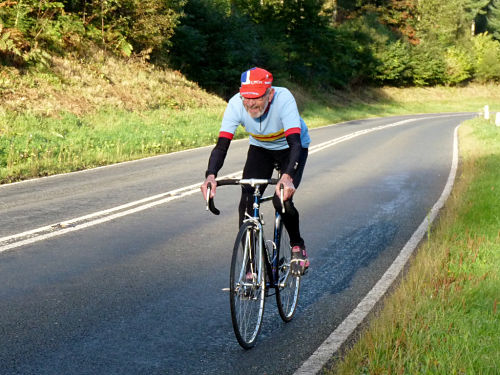
Finally, I’d just like to mention Bryan Bevis. To everyone’s delight he even gave it a go, sporting classic toe straps and a retro club strip, showing that age is just a number and you’re as old as you feel. Well done Bryan.
Bryan Bevis
It was a perfect autumn morning apart from a slight breeze and I remember while riding from the HQ to the bottom of Clay Bank that there were going to be some good times. I pulled over to have a chat with Rob Carter; he was giving short replies while warming up on his trainer. Typical Rob, he played down his chances but you could see that he meant business. At that moment I didn’t know to what degree but we soon found out later!
Other people hanging around were Josh Teasdale, Harry and Charlie Tanfield. Josh was rubbing in leg balm and being quiet, while Harry commented, “you wearing your helmet Josh?” With a reply coming back of “Na, Just my Shades!” Which I think got a slight surprised reaction from Harry. Later while watching him crest the hill he also had gone for tradition and was sporting a cloth cap. Chapeau, Mr Tanfield.
Harry Tanfield
I pulled up to the line with four riders to go. Shaun Tyson was chatting, recalling how he had ridden and in what gear, whilst the riders yet to go off were nodding in agreement but with signs of “hmmm” when he mentioned that he’d used a 53×23 gear. I was also going to use a similar gear but sporting a compact chainset. I hadn’t heard any times as yet but I was next to go off. I made sure that I was in the right gear and that everything was correct.
Now the next five minutes are a bit of a blur but I shall try and recall them to the best of my ability. 5, 4,3,2,1, go!! That was it. I remember sprinting to get up to speed thinking that I need to get to the fence at the half mile segment in under 1:40; I just about managed it with my heart rate about 170, bang on. I kept going and tried to get a rhythm going, my strategy was to climb out of the saddle as much as I could. Everything was going OK, but then I started to struggle in the mid section. I thought, “Go on, keep going”.
I rode past Ben Honeysett looking like Borat, he was stripped down to just his bib tights, and waving a water bottle and shouting. Now I suppose one should never let their mind wander while doing something so demanding but I couldn’t help thinking. ‘What the heck.’ As I passed two thirds distance I could see the crowds at the top waving and cheering, nearly there I thought. I was sitting down at this point but with two corners I needed to give a bit more so I clicked up a gear, stood up and started to sprint for the line. Dave, Rob, Shaun Joughin and a few others were stood at the finish with a clip board and camera in hand. Finished!! I rolled over the finish line and crawled into the car park exhausted but pleased with my effort. As I was now a spectator myself, I could see the growing crowds waiting in trepidation to see the pain and suffering on each of the riders faces which were left to come. Rob had already finished, but I knew that he had done a good time, now we just had to wait.
I can’t remember in what order they came up but it was time to watch the pre-event favourites which were Harry, Richard and Josh Teasdale. Richard came up giving it everything and he looked good then Harry came into view sporting his fluid pedalling stroke and spinning a 39 x 23, finally Josh came up turning what looked like a massive gear for his size, lurching back and forth he crossed the line. That was it, now we had to wait for the times. I was stood with Mike Cole at the time and after a quick calculation we had a winner. To everyone’s surprise Rob Carter took the win in a time of 5:50. Now I say a surprise. That may have been the case for some as it was his first hill climb, but for those of us who know him it wasn’t so. We had him down as the dark horse and although it was always going to be close between the top three, I would have put £5 on him. Second and third went to Josh and Harry respectively with only a handful of seconds separating them.
In the club competition, Richard took the win again beating me into 2nd place also by a small margin. I was a little annoyed but I did beat my arch nemesis, aka Mr Dave Kirton, by nine seconds. Harmony can now be restored once again, and we can both relax until next year when I’m sure our little competition will resume.
Graeme TateDave KirtonRichard Lilleker
After everyone had recovered we all trundled back down to the headquarters to fill our boots with cakes, pies and many a beverage. Non-alcoholic I may add. The results were finalised and the winner was presented to the crowd and applause was given. Rob also got his photo taken allowing him to stake his claim as the winner of the ‘new’ Cleveland Wheelers Hill Climb.
Rob Carter
Thanks to everyone who took part, whether riding helping to organise the event, doing time keeping or just baking some lovely cakes.
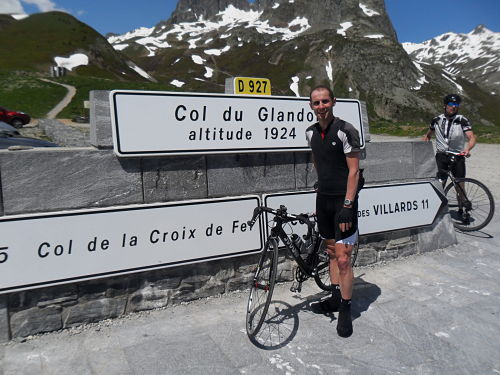
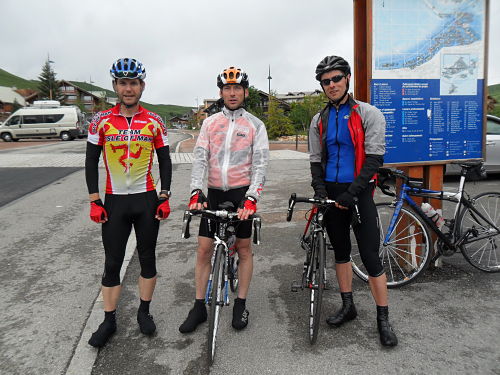
The summit of the Col du Glandon 1,924 metres above sea level, or nearly 6 Roseberry Toppings in local money. The highest I’ve been on a bike but in around 3 or 4 hours I will be higher still, the mighty Galibier beckons and another 2 Roseberry Toppings can be added! The Glandon was tough enough though 24 kilometres of steady climbing albeit with a few short flat or downhill sections to break up the relentless slog. As it’s our first ride though that slog is anesthetised a little by our fascination with the stunning scenery, towering mountains broken up by mountain villages, pristine reservoirs and a thin sliver of twisting tarmac populated by cyclists, for this week is Marmotte week and we have just nailed its first climb.
The descent off the Glandon is something else, all 20 kilometres of it. For the first few turns the road drops away and normally confident on descents I lose my nerve and reach for the brakes more than I should, it takes me a few kilometres before I relax enough to descend properly. Alps veteran Dave leads us ably down, the other three of us, myself, Ian and Graeme, all Alps virgins, are happy to follow. The descent ends at the small town of Saint-Étienne de Cuines and after a brief stop for a ‘natural break’ we tackle the valley road towards St. Michel de Maurienne and the foot of the Col du Telegraph. It seems weird to be on a flat road again after about 3 hours of pure ascending and descending but this grind along a straight busy main road through the hot valley is something that drains us all. So much so that I for one am almost relieved to get on the lower slopes of the Telegraph. Not for long though. The Telegraph is almost an aperitif to the mighty Galibier with only a short descent separating them, but only 3k into the 11.8 k I don’t feel so good and only 50 odd miles into a 100+ mile ride it is a worry. The worry for any of us at this point is between us and where we are staying are huge mountains that need to be got over. The Telegraph was hot, very hot, I sometimes struggle to eat when it like this and a quick check of my food tells me that I simply haven’t eaten enough. So I force some bars down and by the top things feel okay again.
The top of the Telegraph finally comes with the promise of a lovely cool water tap.
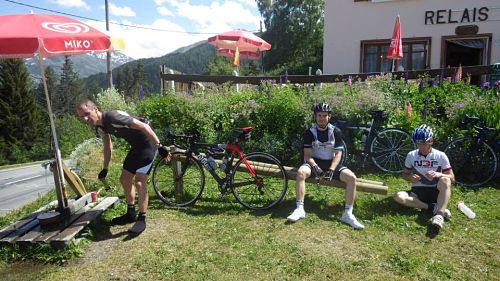
Me, Graeme and Dave taking on water at the top of the Telegraph, Graeme looks a bit fed up and we still have 50 miles and the Galibier to go!
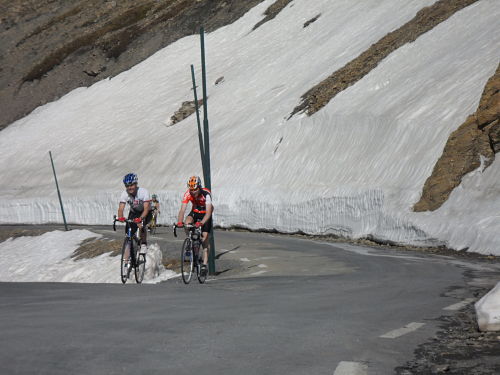
Now the little matter of the Galibier. I’ve never done a climb like this before and it will stay in the memory for a long, long time. I’ve watched the Tour go over it on the TV many times but until you’ve ridden a bike up it I would say it’s impossible to appreciate what it puts you through physically and emotionally. An incredible climb, especially the last 8k. We all have to grapple with our inner demons up this, the most demanding section. Not only is it the steepest section, the air’s thinner as it goes up to 2,645 metres and your energy is diminishing with every pedal stroke. Ian in particular is having to ride round a chronic knee problem and I can’t begin to appreciate the difficulties he’s encountering. Dave’s ‘dashboard warning lights’ are flickering and Graeme has been cramping up since the bottom. As cyclists always do we make it to the summit in our own way. The final 3k or so is spectacular stuff as the road rises up cutting through the snow in a series of hairpins. After the longest climb of my life the top comes and for some reason seems to be populated almost entirely by a large group of German cyclists hugging each other and shouting in their ecstasy. Very un German like but this is the significance of the Galibier and reflects what it means in Tour history and cycling folklore. With typical English reserve I stare out in awe at the panorama that unfolds and the start of the descent that awaits us. The Galibier doesn’t muck about, at the top it simply veers to the left and heads straight down again.
Dave and Ian about to summit the Mighty Galibier
A combination of cold hands, meaning I can’t feel the brakes, and huge chasms all around means that I adopt an approach to descending akin to that of Wiggins in the wet on the Giro. A Kirton café stop at the point where the Galibier joins the Col du Lautaret refuels and reheats us and Dave’s promise of a 20 mile descent back to our accommodation surprisingly proves to be more or less true! The deadline of a three course evening meal at 7.30 focuses the mind and the excitement of a series of dark tunnels which heighten the sense of speed finish off what is a classic route. If we so chose we could have ridden the 3 miles to the bottom of Alpe D’Huez and grovelled up it to complete the Marmotte route. But instead we chose food and putting our feet up.
That was our first ride, we did it because we were all fresh, the weather was good and Ian’s knee was as good as it was going to be. It also meant that another big ride could be done later in the week for Dave, Ian and myself and Graeme could prepare for his Marmotte ride. As well as the four of us there was also Rob who had travelled over a few days earlier. When we arrived Rob was lounging about having just completed a gruelling sportive. I don’t think I am being unkind when I say that like a lot of good athletes Rob has perfected the art of lounging about, laying down at every opportunity, rarely standing, in fact generally not really moving about much. He actually moved about four times in the first 2 days that we were there. Once to make us a cup of tea as we assembled our bikes, which was very nice of him, once to walk up stairs for his tea, the next morning for his breakfast (he did get our bikes out for us while he was on his feet – not his own as he wasn’t going for a ride) and then again for his evening meal.
Le Velo Jaune, our home for the week and scene of much ‘lounging’ and eating
Over the week I began to have my doubts that he rode a bike at all as he extolled the virtues of ‘resting up’ and ‘less is more’. At one point he did ride the 3 miles into Bourg D’Oissans to get a sandwich and a pizza but I suspect that if a bus had rolled by he would have got on that. It was worth noting that he didn’t apply this ‘less is more’ philosophy to food and managed to pack plenty away, though not as much as Dave it has to be said. In fact at one point I thought that Dave might start eating the scenery! So just to be on the safe side I decided to take a few photos. At the end of the week though Rob proved the value of his strategy by finishing at the sharp end of the Marmotte field, then launched himself up Alpe D’Huez the day after in around 47 minutes.
Rob ably demonstrating the art of ‘Less is More’
Each of us had their own particular things that we wanted to get out of the trip and over the next three days we did a series of less ambitious rides that nonetheless took us into some stunning environments while helping us to cover some of the hallowed ground that the numerous wheels of the tour has rolled along. A highlight for Ian and myself was a ride that we did after our Galibier day referred to by our hosts Alan and Lynne as the Balcony Route. We wanted a relatively easy day to recover our energies a little while not stressing Ian’s knee too much. We decided to combine this with the ascent up to Les Deux Alpes. The Balcony Route is accessed from turn 16 off Alpe D’Huez and follows a road that cuts across a fairly vertical cliff face in spectacular fashion, tunnelling straight through it in some places.
The Balcony route, Ian is looking decidedly nervous about what may lurk in the tunnel! I told him about the trolls afterwards.
Why and how they built a road up here I have no idea, but I’m glad they did as it is every bit as spectacular as going over the big cols, albeit it in a different way. After turn 16 off the Alpe the road continued upwards at not much less of a gradient and then takes you to the edge of a cliff where you can look straight down at the valley from which you’ve come. Once you’ve reached the high point the road then drops in an exciting series of twist and turns until you reach Lac du Chambon. From here we road the 10k up to Les Deux Alpes before descending halfway then taking another spectacular mountain road that took us back to our starting point. All this in 28 miles with only 3 of these being anything other than a significant slope one way or another. The 11-12 mph average speed and 2 and a half hour ride time tell you all you need to know, other than we rode really slowly!
At this point I must mention Alan and Lynne who run Le Velo Jaune where we were staying. A more ideal place to stay for cyclists wanting to ride in the French Alps I can’t imagine. The accommodation is perfectly set up for cyclists and their bikes with great attention to detail and is very competitively priced in an area that is in many ways relatively expensive. They are both very active cyclists themselves and are incredibly generous in the time that they spend talking all things cycling, the advice that they give and the information that they have at hand. In fact Alan even accompanied us on some rides, more of which later. For anyone who’s interested here’s their web page www.bourgdoisansbandb.com and I’m sure that Dave, Rob, Ian and Graeme as well as myself would be happy to share their experiences of staying there.
At some point the Alpe had to be tackled. When I asked Alan he said that it was his least favourite climb in the area and after riding up it I could understand why he would have that view. One thing cannot be denied though, Alpe D’Huez has something special about it. Rising straight out of Bourg D’Oissans to the village of the same name at the top it is a Mecca for cyclists, all cyclists. To get an idea of its popularity think Roseberry Topping and the range of people who struggle up its slopes. People were riding up the Alpe on all manner of bikes, I even saw someone tackling the lower slopes on a BMX. I doubt that happens on the Galibier! Funniest moment was a lady riding up on an electric bike breezing past roadies as though she were going down a country lane. Its accessibility is both its strength and its weakness, if you don’t like crowds this is not the place for you. When riding up it you can almost smell the tour battles of yesteryear as the distinctive hairpins provide very specific reference points. Of all the climbs we did this one was more or less as I imagined it. Dave, Ian and myself decided to ride up it at a decent tempo while Graeme pressed on to set a Strava time of around 57 minutes. We went up in around 1 hr 4 and it felt relatively comfortable at that, the hairpins helping as you count them down from 21 to 0. It’s at its steepest, maybe 9-10% or so, until turn 16 but after that is relatively benign at around 7-8% and if you can find a rhythm is quite a nice climb to do. If you’re racing up it I suspect that it’s a very different matter though. At the end of the week Dave returned along with Rob to enter an event called ‘The Grimp’ and set a time of 51 minutes something accompanying Rob’s 47. To say that Dave was pleased with that was an understatement. I think that I could maybe have found 5 minutes or so from our tempo ride but no way could I have gone 13 minutes quicker. Dave’s finest ever ride? I think so.
At the top of the Alpe! Dave, Ian and myself, Graeme is on photo duty
We returned to the top of the Alpe the next day albeit via a tough little climb of the Col de Sarrene. This 13k ascent took us up to the village of Alpe D’Huez another way, from the opposite direction to the classic route, but in many ways it was just as hard. We rode up the way that the Tour was shortly to descend down on their ‘Double D’Huez’ day. Ian had a particularly difficult time as he knee gave way just before the top. It and he had done remarkably well to get this far and it was somewhat of a relief that he was able to make it up. I had my own problems as further down the climb on what was a hot day I dunked my head in a cold trough of water. Dave thinking that this was a great photo opportunity missed persuaded me to do it again and rather stupidly I agreed.
Note to self, when Dave has an idea take time to think about it. Better still don’t do it at all!
The water was ice cold straight off the mountain side and the resultant double dose of cooling gave me what can only be described as the worst of all Ice Cream headaches. At one point I thought I was going to pass out or be sick and getting back on the bike and resuming the climb was difficult and it took a few kilometres (I was thinking in k’s rather than miles by this point) before I felt okay again. After the top of the col and sighting a couple of soaring eagles we made out way to Alpe D’Huez where we bumped into Rob who was there registering for his Marmotte ride. He told us he ridden up but I was somewhat sceptical that he would have expended such energy and wondered if he’d found an alternative way up maybe via cable car. He did join us in the half mile ride to the café with a rather spectacular view and the subsequent descent down the Alpe. A 14k descent through a series a hairpins completely solid with cars and other bikes required keen concentration and got the wheel rims as hot as a radiator through braking and it was with relief that the bottom was reached before a tube blew. For Ian this was his last significant ride and it was a real shame that he couldn’t join me and Dave for our big ride the day after.
That night over the meal Dave, in a way that only he can, was explaining how we would ride up the Col du Galibier from the other side via the Col de Lautaret. Forgetting that I had descended the 40 odd kilometres of this four days earlier so knew the terrain he merrily pressed on saying that we could somehow breeze up around 2,000 metres of vertical ascent through a mixture of ‘going steady away’, ‘soft tapping’ and ‘glass cranking’. Rob who was of course resting up with his ‘less is more’ approach was rather mischievously encouraging Dave along suggesting that we also nip up and down the 20k 8% climb of the Col de la Madeleine and then finish with a 29k ascent of the Col de la Croix de Fer. Three huge cols when earlier in the week Rob had warned us of the dangers of doing anything more than 2! Undeterred or completely oblivious Dave carried on moving his finger along the route on a two dimensional map and failing to appreciate that mountains existed in three dimensions and that the map was scaled down somewhat in the way that maps are! Just when I was about to accept my fate and a long hot day of suffering reason intervened in the form of Alan who offered to ride with us on the condition that we did his suggested and much more reasonable route of a mere 153k rather than Dave’s mammoth 200k three col horror. Saved!
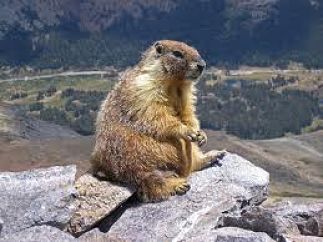
‘There’s a marmot’, ‘There’s a marmot’, ‘Another, a big fat one on a rock, 5 metres away’, said Alan.
A big fat Alps Marmot on a rock after which the cycling event is named – there’s loads of them!
Dave and I were now tuned into marmot spotting, they were everywhere, much like rabbits are in the UK. We had cycled this way up the Glandon 4 days before yet hadn’t seen any and now here was Alan pointing them out all over the place. How had we not seen them! For those who don’t know, as I didn’t, they are a kind of cross between a beaver and a squirrel and live in holes high up on mountains. And they are quite big, bigger than a rabbit so not really difficult to see. So as well as being a strong cyclist, knowing the roads like the back of his hand and having an invaluable knowledge of all water sources en route Alan was also a marmot spotter extraordinaire.
Near the top of the Glandon the road branches off right and heads towards the impressive summit of the Croix de Fer – the Iron Cross – at 2,067 metres. A steady but not too challenging gradient takes us the 3 miles to an impressive vista of high peaks.
On top of the Croix de Fer
The descent that followed cut impressively though the valley and if we had followed it all the way would have lasted an incredible 29k, around halfway though we deviated from this to take in the Col du Mollard which was included in the Tour in 2012. A 5k ascent was followed by, for me at least, the finest descent of the whole week. Not as predictable as the hairpins on Alpe D’Huez it was probably just as twisty and in some ways more intricate. What really made it so good though was the fact that it was virtually free of traffic and offered great views as we descended 16k into St. Jean de Maurienne for something to eat. I’m not sure that a large pizza is ideal about 8k before grinding up the Glandon from the steep side on a hot day but that is what we opted for. Dave was impressed by the number of pizzas offered on the menu that we were browsing through while trying to find shade from the heat of the midday sun and expressed his awe and wonder to Alan.
‘Not surprising really Dave, we’re in a pizzeria!’
I’m used to this kind of comment from Dave but it tickled Alan. Whatever was in that pizza that Dave had must have been on the banned list because 13k into the Glandon climb Dave announced ’I’m just going to have a poke up the road’ and shot off with 7k of the climb still to go, including a really tough final 3k. Alan looked concerned but I’ve seen Dave do this kind of thing before and simply said that ‘he’ll probably be okay but don’t be surprised if he runs out of steam near the end of the ride as he’s quite unpredictable’. One thing’s for sure I doubt that I could have followed it and I just continued at the level of effort that I’d set from the bottom of the climb as I didn’t want to risk blowing up. Like many of the big climbs at each kilometre a marker informs you how far you have to go and what the average percentage for that kilometre is going to be, which I find does actually help you to measure your effort. The bulk of the climb is almost uniformly between 7 and 8% but the final 3k is pretty tough at around 10-12% for its entirety. Dave had sustained his effort though and was probably around half a kilometre ahead of me and Alan up the road. It has to be said that Alan seemed quite comfortable at the pace that I was setting whereas towards the top I was starting to feel it and was glad to see Dave propped up against the summit wall suffering for his efforts. The descent was really a case of how fast dare you go for many of the sections and Alan’s local knowledge made speeds of 40-50 mph seem relatively comfortable although I struggled to keep near to his wheel for some of the twistier sections. I actually felt quite fresh towards the end of the ride and overall I felt much more consistent than during our earlier big ride.
It’s Marmotte day and Ian, Dave and I have found a shaded spot under some trees near turn 16 on the Alpe, which is just as well as the temperatures are nudging over 30 degrees. We’re here to watch the masses struggle up the 21 hairpins with 160k of tough road already in their legs. And struggle some of them do but we do what all cyclists do when they’ve also been through this kind of thing: shout meaningless encouragement, laugh and wince. Dave decides to pick out British riders and shout at them a bizarre mixture of things taking his cue from their club jerseys. ‘Go on Pennines CC’ or similar kind of makes sense, but soon he is losing his way and is just picking anything written on a jersey ‘Dig in Websters Cavity Insulation!’. He is a man either losing his mind, affected by the heat or both. We let him get on with it as he’s doing no harm. In among all this we manage to pick out Rob and then Graeme who are both well up and local Teesside cult figure Mark ‘Mad Dog’ Jenkins who is doing well too despite managing to come off on a descent of the Alpe earlier in the week. Fellow Cleveland Wheeler Tim Swales is in there somewhere too but unfortunately we can’t pick him out among the 7,500 cyclists that will have put themselves through this.
So that was it the holiday more or less over, just the packing and the stress of the train journeys to sort out for me, Ian and Graeme. Dave was going to squeeze in his last glorious foray up the Alpe as was Rob who was also going to spend a few extra days of riding before heading home. The question I’ve been asked since I’ve got back and the question that I suppose I asked myself before I went is: what are those climbs like? How do they compare to Clay Bank, Rosedale Chimney etc? Well they are just totally different. When you think about climbs at 6-10% you think so what? But it’s the length, the heat, the scale, the majesty of it all. It can be quite overwhelming at first but it’s doable. If I can do it so can most club riders, it’s long sustained suffering rather than the short intense suffering that our climbs inflict on you. It sounds strange to say it but there were very few times where I was breathing that hard but to counter that I don’t think I’ve had to deal with that kind of relentless remorseless toil either, no let up of resistance for an hour, a summit seemingly no closer, the road seemingly clinging to your tyres and making you work for every centimetre gained. It’s epic stuff, why not give it a try?
Distance 5.4 miles from Dufton, around 4.7 from the road end (8 or 9k)
Max Gradient 15%, average 8%
Introduction
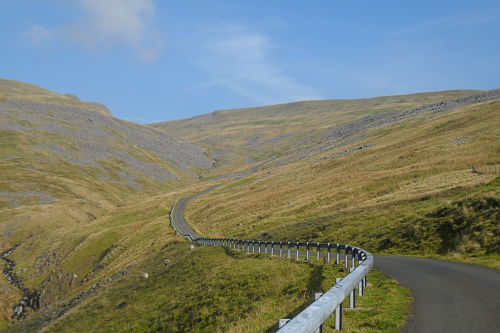
Most climbs don’t get an introduction, but this one is a bit out of the ordinary. What if I told you that there was a road in Britain that finished on top of a mountain that was just short of 2,800 feet? What if that road was superbly surfaced and pothole free? What if this road was 5 miles long, or 8 kilometres if you prefer, and rose at an average just short of 8%? What if this road was through a stunning, dramatic and beautiful location? And finally what if I told you that this road was virtually traffic free? Is he living in dreamland you might justifiably ask? But it’s true. The road up to the summit of Great Dun Fell is all these things, so what’s the catch? Actually there isn’t one. It’s remote, but then that’s a big part of its appeal. The only thing that’s strange about it is why this climb isn’t a Mecca for UK cyclists.
Where do you find it/How to get there?
Normally we don’t include climbs that aren’t in the local area but for this one we made an exception. The nearest town is Appleby in Westmorland but, if you are going out to climb it, it makes sense to take it in as part of a longer ride. We chose Kirby Stephen as our start point and then made our way towards Dufton, then Knock at the foot of the climb. These roads were great cycling country in themselves, free of traffic and providing great views of the Pennines looming ominously to our right. They are tough rolling roads though so I was somewhat surprised to hear what I thought was some kind of auction going on behind me between Ian and Rob as they shouted out 210, 220, 240, 265 etc. ‘Where do they find the breath I thought?’ Apparently they were talking wattage as they have some new fangled Powermeter Gizmos, all I knew was that I had to save as much of it as I could. It was telling that with an unerring regularity we all took turns to look up towards the radar station on top of the fell. The lie of the land here somehow makes Great Dun Fell seem lower than it is. Its rounded shape can almost go unnoticed as you drive past it along the A66 but to put it in perspective it is nearly as high as Blencathra which is the impressively shaped and seemingly huge peak on your right as you enter the Lake District from Penrith. Or only 250ft short of Skiddaw, the large peak that dominates Keswick, and to think the road literally finishes right on the top, a sobering thought.
Description
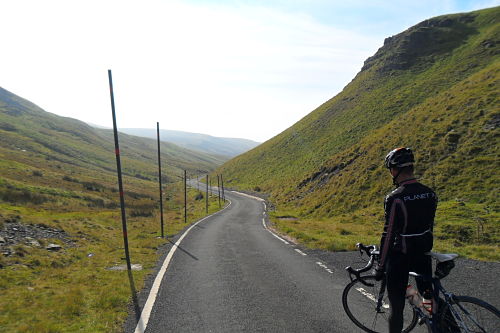
The website www.climbbybike.com actually lists the climb as 9k long and starts it just beyond Dufton where the road starts to rise. The logical starting place though is the right turn at the road end after Knock when you literally start to head for the hills. The road seems flat to start with as you grind your way along a straight section in the general direction of the summit, as your speed drops to an alarmingly slow pace, you hope that this is some sort of optical illusion. If I’d been on my own I would have been checking for the dreaded slow puncture or rubbing brake block but Ian, Dave and Rob are all finding it hard going too. After a kilometre or so you are in no doubt that you are going up as the road swings right ‘if it carries on like this I’m going to be in difficulty’ says Dave. Unfortunately for him it does, at least for a good while yet. Even more unfortunately for Dave he has made the judgement error of just looking at the average gradient of 8% and thinking he can get away with a 25 sprocket. I am smug with my 28 knowing that average gradients can be deceptive and that there are some sustained sections of around 15%. It is also payback for the day last year when Dave spun happily up Hardknott Pass in his 32 sprocket, and I struggled up in ‘only’ a 29; today it is he who will have sprocket envy.
This tough initial section carries for a kilometre or so until it eases as you approach a gate at a cattle grid. You need to stop to open this and then you are faced with another tough steep section, once over this the true majesty of the climb reveals itself as you then enter what seems to be a small dip in the road, probably just about flat in reality, in any case enjoy this while you can. To the left of the road is the impressive chasm of Knock Ore Gill, up ahead are two really steep sections of sustained 12-15% interspersed by a short easier section. This is the real crux of the climb, get over this and the hard work is done, almost.
On its own this two kilometre stretch would probably score a 7 or 8. Select your lowest gear and just keep going until the gradient finally starts to ease and the road swings left towards the dome of the radar station. I chose not to try to follow Rob at this point for fear of blowing and I watched him gradually pull away in his 39×25, a wise choice because bearing in mind how long it lasts I may well have done. He told me at the top that this was the only way he felt he could keep the pedals turning smoothly; otherwise he may have ground to a halt. After riding this section at only around 6-7 mph it was good to have the luxury of clicking up a couple of gears and picking up a bit of speed as the percentage went down to something like 5%. This next half mile allows you to get some of the lactic out of your legs, this is just as well as there is a final cruel ramp up to the summit, again 12-15% for a couple of hundred metres. A few more pedal turns and you are on top of the second highest point in the Pennines, only the neighbouring Cross Fell is higher and only marginally so. All that is left is to cross the bumpy cattle grid, claim the summit and marvel at the views in all directions, simply magnificent.
Descent
Brilliant but you need to be careful of the speed as 50 mph + is easily achievable. Sheep seemed to like the top but weren’t around on the rest of the climb. The surface is just about perfect but the road does dip and roll and has some tight corners at a couple of places so you do feel that you get thrown around a bit and you need your wits and concentration about you, there are a couple of places where coming off would be disastrous. Once past the cattle grid and gate the bottom section is quite straight and with a tailwind it would be a top speed personal best opportunity I would think.
Sheep Rating (out of 5)
Not too bad but plenty around the top.
Photos
About halfway, looks like a downhill dip, in reality it’s probably flat, up ahead lies the hardest sectionIan looks downhill; we’ve descended about a kilometre at this point.The top! Rob probably checking his power readout while Dave takes a well earned rest, is he grinning or grimacing? Meanwhile Ian is seemingly in despair with his head in his hands!
Our Ratings and Comments
How hard is it?
Paul. It’s long and sustained pain rather than intense excruciating pain that you sometimes get with the Moors climbs, but the duration – it took us around 35 minutes to climb it – makes this a serious proposition. You also have to consider where you are going; conditions can get very serious up here. We were fortunate enough to have a near perfect wind free day and it was still tough. With even a moderate wind coming down off the fell it would be marginal for most riders I think. Even the bottom bit, which bizarrely looks flat, is tough, similar to the bottom section of Birk Brow from Charltons and draws something out of you before it really starts to rear up. This was confirmed when on the descent we approached 40 mph on it without too much effort. Best climb that I’ve done I think and all things considered then it’s a 10 for me.
Ian. It’s a 10 from me. It’s the hardest climb I’ve ever done, the anti clockwise sweep of continued blind summits with such an over bearing in-crouching landscape is not for the faint. I loved it for its unremitting suffer fest in such a beautiful landscape & it’s a bonus with the lack of traffic.
Rob. Second that Paul, brilliant day, cheers lads. My thoughts on the climb are as follows: having had a few hours to reflect personally I was blown away with the length of the climb (8km approx) and difficulty. I felt I couldn’t get into any sort of rhythm on the climb due to the constantly changing gradients. The length of some of the steeper sections (12-15% in places) surprised me and I was really hurting towards the last couple of km. Personally I prefer and was expecting a constant shallower gradient but I was really glad to reach the top that’s for sure! Definitely made a big mistake with my gearing, 39×25 was just way too big a gear when you consider the length and steep gradients. Let’s not forget also that the climb was done in perfect conditions with hardly a breath of wind. So to summarise: I’ve done nothing like it before in the UK, and I think it would test riders of all abilities for the above reasons. I would therefore have no hesitation in giving it a 10/10 difficulty rating.
Dave. My thoughts on the climb? The closest thing in the UK to an Alpine or Spanish climb, but very much like Mont Ventoux, but with UK steepness thrown in for extra difficulty. Wouldn’t like to climb it in poor weather, superb road surface, but I’d opt for a 34/28 next time. I can only award it 9 as at no point did I think I wasn’t going to get up, but it is an extremely difficult 9+. As for Rob and Ian with their power meter talk, all I needed to know was that at several sections I thought my heart was going to pop out my throat and that I had used all my watts just to get up to the top. Great day out though, would love to see the Tour of Britain go up there. Spectacular.
He couldn’t conceal the look of disappointment, despair even, worse than any defeat he’d suffered in any race, ever.
‘Never mind, I’m sure other cafés will be open’, said Dave, trying as always to think positively.
‘But I like this one, and will they do eggs on toast?’ asked Rob.
‘I’m sure they will’, said Dave reassuringly and then he consulted his internal mental map of all the local tea shops and cafés that were available to us within an hour’s ride before giving us our options.
We considered these as we sat astride the top tubes of our bikes trying to summon up the mental energy to make our way from Castleton Tea Rooms over towards Great Ayton. It didn’t matter how many times Rob looked forlornly at the tables inside, the lights weren’t on, it was definitely shut. Like it or not we simply had to press on. The night before Dave rang me about the ride to say ‘Rob Carter’s coming out’. Normally this would make me think twice, not because I don’t like Rob, he’s a nice bloke, but it’s the pain it would involve you see. Rob is an incredibly strong rider, he competes regularly in Premier Calendar races, as well as doing well in the National Road Race Championships last year, and even an easy ride for him is probably an on the limit ride for me. But before I could think ‘do I really need this in February and only three weeks after an appendix operation’? Dave explained that Rob just wanted to casually potter round some cafes. Great! I thought an easy ride, perfect, but it just didn’t seem to add up based on what I knew of Rob. What I didn’t know is that since I last rode with him, when he was in great shape and powering up Rosedale Chimney, he had succumbed, temporarily at least, to the Dave Kirton School of cycle training. Some might say ‘the Dark Side’.
Not me though. Before I rode regularly with Dave I rarely stopped at cafes, preferring to refuel when I got home after the ride. Now I am a convert, what could be better than passing the day away with your fellow cyclists while you enjoy a brew and a teacake and reflect on the ride you have just done along with planning your next one? As we rode up Rob was already in this mode of thought as he talked about the excitement, not of his upcoming stage race in Morocco, but of all the cafés that he would be riding to today and what he would be eating in each. Cycling would just be a means of getting from one café to another. He was keeping the watts reading low on his Powermeter as he set himself the task of riding at his easiest possible training level as the three of us made our way up over the moor from Lockwood Beck, so this is how he does it I thought? The climb dragged on and I for one was approaching my limit, soon though we were over the high point and descending into Castleton.
And now here we were as Rob looked to Dave (his café stop mentor) to lead him safely from this place of disappointment to the promised land of eggs on toast. The pressure was on and just after we set off again it quickly became clear that Rob’s mental strength just wasn’t where it needed to be, not in cycling terms you understand, it was just… well Great Ayton was simply too far to go and too long to wait. Dave and I looked at one another, we clearly had a crisis on our hands, I imagine that it was like becoming aware that your team leader in the Tour simply couldn’t face going over one more col. I suggested in desperation of trying the Cleveland Inn in Commondale, which was only three miles away, and Dave clung to this. So I then felt pressurised to exaggerate the menu that might be available, remembering a chip buttie that I had many years ago but beyond a that and a pickled egg I was struggling. Rob was fixated on eggs of the fried variety though and digging deep into his suitcase of café knowledge Dave rashly promised Rob that all he could ever want would be available to him in Kildale. The day was seemingly saved and with morale restored the undulations between Castelton and Kildale were miraculously smoothed out, well sort of, and eventually we got our man to the end of the first stage.
Once seated comfortably inside the café the first question Rob asked was ‘Do you do eggs on toast?’ The look from the proprietor suggested that the worst was about to happen, the answer would be no and we would have a broken man on our hands, a man who would give up the bike there and then on the spot and demand that we ring for a taxi. Thankfully we misread the look and ten minutes later the crisis was over, the food was delivered, spirits were high and the next café stop and all that it promised was being discussed. A 35-40 mile ride was enough for me though so I peeled off and made for home, my support role complete as I left them to complete their odyssey. Later in the day I got a text from Dave to let me know that they’d done 55 miles with three café stops – mission accomplished. Dave, his new (or maybe old?) training methods steadily gaining favour, will no doubt be taking credit for laying the foundations for Rob’s upcoming season.







 Cleveland Wheelers