As you know long time club member, John Johnson, was tragically killed whilst out on a ride on Saturday 12th September, 2009.
John joined the club around 1974 as a 16 year old and soon became one of ‘the group’. He very rarely missing a club run and competed in most types of events: time trialling, road racing, and cyclo cross. His name appears on a number of club trophies and his main claim to fame was winning the TCA hill climb at Kildale in 1977. He was also elected to the club committee for a short time in the late 70’s.
However my main memories are of those club runs and his fearless descending. Two instances spring to mind :-
Descending from the Bilsdale mast and bouncing off the safety barrier but keeping upright and
Descending the side of Clay, missing a corner and disappearing down into the woods. The rest of the club run laughing at his misfortune.
He was also a member of the quartet who used to always sing (very badly) at the top of our voices as we rode along. The other members being Andrew Allen, Steve Maidens and myself. John loved his music, The Moody Blues being his favourite band after he was introduced to them by my brother, Mike.
John met his wife in 1980 and they got married in 1981 a day I again remember very vividly as I was his best man, a job which I was very proud to undertake.
John leaves behind his wife, Angela, and sons and daughter, Andrew, Philippa and David.
RIP John
Happier days – left to right Steve Maidens, Steve Binks, John Johnson, Ray Burnett and Geoff Reynolds. Sadly, Steve Binks is now the only one still with us. Steve Maidens died around 1988, Ray Burnett in 2006 and Geoff Reynolds in 2008.
I watch quite a lot of cycle racing on TV, an unhealthy amount some might say. So the voices of David Harmon and Sean Kelly have almost become part of the household. I’ve never really given it much thought I just assumed that everyone enjoyed them as much as I did, until the other day that is. Over the last year my wife Shelly has started to enjoy watching cycling, and Mark Cavendish in particular. While I’m a fan of Cavendish myself it is a little like supporting Man Utd, ‘oh he’s won again, what a surprise. Somewhat naively though I assumed that she enjoyed the whole experience. So imagine my horror when during a stage of the Vuelta she referred to the legend that is Sean Kelly as ‘that boring bloke’. First I went upstairs to get my Kelly biography from 1985 so I could start reading out his palmares, and remember that he raced for a number of years after this. ‘He won the Green Jersey four times’ the Paris Nice seven times in a row, the Vuelta, Paris Roubaix twice…’ and on and on I went. It wasn’t until I mentioned that he likes donkeys that she started to warm to him a little, sadly this wasn’t enough though and she stuck by her view.
I struggled to come to terms with this to be honest and found myself offloading my anguish to Dave Kirton as we trained for our upcoming Coast to Coast ride. As I recollected my wife’s comments he sympathised saying that his fiancée Rebecca had much the same opinion (she confirmed this later when she met us as we looked at Dave’s collection of bikes – something that gives us all pleasure). Dave said that he finds Kelly’s voice quite soothing which adds to his enjoyment – maybe the great man should develop a sideline of reading children’s’ bedtime stories? I must remember to write to him to suggest that he gives this some thought.
What troubles me more though is that fellow riders who are too young to remember Kelly as a rider, or are new to the sport of cycling, might have much the same opinion ‘that boring bloke on Eurosport’. In the modern peleton there isn’t really a rider that you could compare to Kelly, someone who can compete for an overall classification in a Grand Tour as well as winning the points competition yet can also dominate in the classics. On Eurosport David Harmon will often attempt to coax Kelly to talk about his career but he tends to avoid it and remains silent. In fact he famously nodded when asked a question in a radio interview. Kelly is much more comfortable when giving the view from inside the peleton as it were and there are few more qualified to do this. For example he rarely gets it wrong when asked if he thinks a break will stay away, ‘it’s going to be difficult’ he will simply say more often than not and leave it at that. What I like about him is that he doesn’t get drawn into that tendency to be over analytical that so many ‘experts’ do preferring to give simple and straightforward answers that aren’t designed to impress the average viewer. However if you find him difficult to listen to there are a few things that I could suggest that may help. Having spent some time defending him I have to admit that he is economical in his use of vocabulary, so to add interest to your viewing you can play ‘Kelly Bingo’ and count the times that he will say the following and then compare them with subsequent broadcasts:
‘He’ll pay the price’ (when someone is expending effort unnecessarily)
‘It’s not majorly difficult’ (when referring to an easy climb)
‘It’s difficult to say’ (classic Kelly non-committal)
‘He’ll struggle to hang in there’ ( when a rider is suffering like a dog at the back of the bunch)
‘It’s a difficult one’ (a subtle Kelly variation on number 3)
‘errrrm’ (used to get most of his sentences underway)
Or, as Dave does, you can tape him then listen to his soothing tones as a means of relaxing after a stressful day. Either way your life will be enriched and you’ll wonder how you ever got by without him.
In the book Zen and Art of Motorcycle Maintenance it has a disclaimer in it at the start which effectively says that it’s not much use if you want to find out more about Zen Buddhism or motorcycles. In a similar vein this article will not inform you much about cycle maintenance or Len for that matter.
Many years ago, about 23 or so actually, I knew a guy called Len and he rode a bike. Not a very good one it has to be said, especially after he had owned it for a few years. Maintenance was an alien concept to him you see and he would often be mocked by his cycling friends. They would point out that riding around with fraying brake cables, a chain that had no relationship with oil (fancy lubes and the like hadn’t yet been invented) and tyres that had bits of their carcass hanging off them was simply courting disaster. But he took no notice, he didn’t care and poo pooed their advice, until that is his front brake cable snapped as he descended Saltburn Bank. These were the days when brakes were made by Weinmann and didn’t really do much at the best of times, especially the back ones – you don’t know you’re born with modern brakes, you really don’t. A near death experience followed as he used the not to be recommended technique of jamming your foot between the fork and the front tyre. From that day onwards I, I mean Len, became a reformed character but now it’s getting out of hand.
Okay time to come clean, yes it is me I’m talking about, I was that maverick character. Trouble is I’ve become obsessive about everything being just so on my bikes, and what’s more it’s spreading to the bikes of others. It’s been getting worse over the last year as I’ve been doing the club runs. Harry Tanfield’s loose mudguard is driving me to distraction – he knows this and taunts me with it – John Kelly’s loose headset, Mick Rennison’s cassette that wasn’t secured properly, they make me want to stop and fix them. I know that this is unreasonable, they don’t care so why should I? I don’t really know the answer to that. I struggle to ride a bike now if there’s anything wrong with it, the other week I developed a squeak, or rather my bike did, and I convinced myself that it was the bottom bracket but after stripping things down I found it to be a misbehaving saddle! So off it went, no second chances as far as I’m concerned, and it was callously thrown into a spare parts box never to see the light of day again. Similarly some ancient squeaky brakes that I had on my winter bike, ironically they were made by Weinmann, just kept doing it despite my warnings, so they too have gone and will probably make an appearance at the Bring and Buy Sale. Classic Weinmann brakes in resplendent gold circa 1975 anyone?
On reflection though I think that it’s all worth it. Is there anything more enjoyable, more perfect than a well maintained machine as you glide along on smooth bearings, a well aligned chain and properly secured components, it’s almost like achieving a state of Zen isn’t it?
Like most cyclists, I always imagined how it would feel to ride those climbs in the Tour de France that I saw every year. What would it be like to follow in the footsteps of all those great riders? This year, I finally got the opportunity to find out, on some of the climbs anyway.
I got together with Mike Rennison and we decided that we would take a week out and go to France to see some of the action, though my main aim was to ride the mountains. We chose the last week of the Tour, as not only did it have the best climbs, but would surely be the most exciting time to see the pro’s. That proved true as the first two weeks were pretty dull
Our first stop was in Kent, where Mike wanted to take part in the National Disability Championships taking place there. There was a circuit race on Saturday afternoon and a time trial the next morning. With good prize money on offer, we hoped Mike’s hard work would boost the holiday coffers. There were very few competitors in the circuit race and they were staggered in three groups. From memory, only two riders went off first, then three more, then three more in Mike’s group. The defending champion set off over a minute ahead of Mike so it was always going to be tough reeling him in. Despite finishing first in his group, Mike was unable to catch all early starters and finished just outside the medals in fourth, but getting a nice cheque to pay for our shopping in Dover the next day. The following morning, Mike lined up in the time trial, but due to space limitations, he had no TT bike and had to ride on his standard bike and not a tri bar in sight. This proved too much, and he had to settle for sixth place in a very complicated and confusing handicap system. Lack of TT equipment meant he ended up behind people he had ridden away from the day before. Still, a few more euros were added to our funds.
MONDAY
So into France, and immediately the less crowded roads and better weather were in evidence. Our target on the first day was to reach the place Mike goes skiing. It also happened to be on the Tour route this year. He always wanted to do the climb on his bike, so he got his chance. We didn’t get to Les Carroz on Sunday despite making good progress, we had to finish the drive on the Monday morning. We parked the car near the bottom of the climb and headed off to do the Cat 2 climb which the pro’s would do as part of their route the next day. If my memory serves me right, it was named Col d’Araches. The climb was in the region of 6-8% gradient and we rode it together. After 6 km we reached the point that the peloton would turn left, but we carried on up the hill to Les Carroz and then carried on still further to Flaine, the ski resort at the top. I had 26 km on my computer at the top, though 3 or 4 would be flat before we got to the climb. We went back down and had something to eat, then in a while I wanted to ride up again at my own pace for the first 6 km. Not a wise move on a stomach full of recovery drink and rice pudding. I did go up a little faster than before and even managed to keep my food down on the way.
TUESDAY
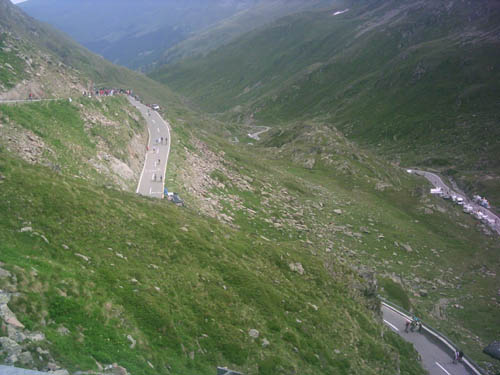
View down from Le Grand St Bernard
After my ride, we packed the bike and headed off towards Switzerland. The highest climb on the Tour route would be to Col du Grand St.Bernard, and we wanted to be there. From the start town it was apparently 54 km to the top of the Col. We went a little outside the town to park, then began the ride up the route. It wasn’t as hilly as appeared on the profile, early parts being flat, but that changed later. We rode 40 km and arrived at the summit, I would say most of it was 5-6% until the last 5 km which kicked up a little more. We went down to view the race near the 1 km sign with the best view of the roads below. After a long wait, two breakaway riders went by, Karpets and Pelozotti I believe, then a few more chasers. We had to wait quite a while before Cavendish appeared, being dragged up by team-mates near the tail end of the field. I got a good photo of him as he passed, and soon we were on our way back down the mountain, trying to dodge roads full of fans on foot making the long walk back down. The descents are pretty scary, and I for one am not a fan of going downhill at speed, especially on twisty roads. One reason for this became apparent on one bend. I was just behind Mike on the descent and we approached a turn. we both braked and Mike’s front tyre blew, right on the bend. He lost control and went down picking up a few minor bruises and cuts. Luckily it was a slow bend and we were already going snail’s pace. We were both to be more cautious after that. A major problem was heat in the rims from continual or hard braking. I had two flats that same day due to it, and Mike had another the next day. On the ride home we were able to do a few hard bit and bit efforts on the flatter roads. A couple of Frenchmen had the audacity to go by us as they were doing the same thing. We let them go, and as they weren’t getting away anymore after a few miles we decided to catch them up. The hammer went down and the next thing we knew we were on our own again. We were already back at the car and changed by the time the two appeared sheepishly riding by having been taught a lesson.
WEDNESDAY
Mike waiting on the Col de la Colombiere
Wednesday was to prove the most difficult day as far as gradient goes. We had two 1st category climbs to get over. We parked the car right at the bottom of the first one on a small “pull-in”. Some events on the day proved just what a small world it can be. We were just making final adjustments and getting food and drink ready for the ride, when I heard a voice behind me say “Hiya”. I turned to see someone I didn’t know from Adam, but he had recognised my Cleveland Wheelers top and walked across the road to chat. He proudly proclaimed to me ” I designed that top”. It seems he was an old CWCC member who came up with the idea of a more snazzy design. I remember he was called Adrian and that’s all I remember. He headed back to his wife and continued on his way up the hill along with many others on foot.
The ascent was the steepest we had encountered so far, not only steep but very twisty roads and huge drops into the valley at the side. We had only gone around a couple of bends and already the town was miles below us. This was the Col du Romme It wasn’t long, maybe 8 km, but it was steep, in the 8-10% range. I rode alongside or just behind Mike, letting him go at his own pace. I was already worried on the way up about going down the same way. We had a back-up plan in place in case of such a problem and we both agreed we’d rather find a more gradual and less twisty way back to the car. With the Romme behind us we headed downhill to the next climb, the Col de la Colombiere another 1st cat. On the descent it started to rain, not only that, Mike had another flat tyre. We checked his wheels, his rim tape was all twisted up and basically melting with the rim heat build up of braking. We couldnt untangle the rim tape, all we could do to stop the inner tube going down the spoke holes was to put a patch over it. It worked for the rest of the ride, but the next day Mike changed to his spare wheels for peace of mind.
It rained quite heavily on and off as we climbed the Colombiere. We stopped maybe two or three times on the ascent to shelter, and maybe that’s why it didn’t seem so tough to me. It felt like the easiest climb we had done all week, it wasn’t even long, I think 6 km at most. In my opinion the Romme was much more difficult, and Mike agreed. In a way I felt disappointed. I knew the name of this climb and yet it proved no harder than four times up Clay Bank at 80% effort. While the Romme gave the impression of a 10% climb, the Colombiere seemed more like 7-8%. Maybe my view will change if I go up on a hotter day without a breather on the way up.
After the action was over, we followed the peloton over the top in search of a gentle downhill to get home. The stage would end in Le Grand St. Bornand. We were both delighted to find a nice route with less twists via Petit St. Bornand, a nice downhill followed by flat roads through the valley back to the car. We were even able to get a spell of “Time Trial effort” going on the way back. As we cooked our meal, cars were still coming down from the summit. A voice from a car shouted “Hi, I saw your Cleveland Wheelers shirt, I’m from Stokesley”. Truly a small world.
THURSDAY
Geoff at the top of Alpe d’Huez
With the rather overcrowded Annecy time trial as the Thursday stage, I for one preferred to go and do something more challenging that pushing shoulder to shoulder with Americans trying to get a peep at blurs going by at 35 mph. We headed off to the Mecca of cycling, Alpe d’Huez. Mike is already an old hand at going up this epic climb. On arrival we decide to drive up first, and it will give me a look at the route before I tackle its 21 bends. This was to be my first “solo” ride, as it was the one I wanted to time myself on the ascent. We headed down to the bottom on our bikes having parked near the finish line in the large car park. Mike being a downhill specialist and on his trusty spare wheels, went on ahead and was already around the roundabout and starting the climb as I limped down, I got a flat again just after the last bend luckily. The heat in the afternoon was almost unbearable, and here we were attempting to ride up the iconic climb. I set about fixing the puncture and Mike stopped to see if I was OK.
Puncture fixed, Mike carried on up the climb as I fiddled to secure my crash-hat to the bars somehow, as I didn’t want to be wearing anything on my head going up there, it really was baking hot, and as if that wasn’t bad enough, it was blowing a gale too. A couple of minutes after Mike left me I headed off in the opposite direction to the roundabout which signals the beginning of the climb. As I rounded the roundabout, I set my mileage to zero and started my stopwatch. I wasn’t sure of the exact place to start the watch, as it turned out, I started it a little early, but only a couple of seconds early. The first couple of minutes is flattish, then you get to know what a Hors category climb is all about. I was sweating buckets. The gradient is only supposed to be 7.6 on average, I was expecting to hold 14 kph comfortably as I do up Clay Bank sitting in the saddle, but it wasn’t to be. Most of the time i was hovering between 11 and 12. I was constantly wiping sweat from my eyes. i hadn’t sweated so much since I rode a similar climb in the Philippines, but that was only 7 km long, and this was 14.5. The only kind of recovery I found was on many of the bends, which seem to level off, especially towards the outside. I took a wide turn on each one and at the same time a mouthful of water. I started with 1.5 litres and it only just lasted, i could have done with a little more. I passed Mike who was really feeling the heat too. I was sure he would be stopping to put his head under one of the waterfalls at the side of the road, but he promised me he didn’t. I wouldn’t blame him, they were very inviting. I kept passing rider after rider, but the numbered turns seemed to be going by very slowly. Eventually I got to what is the first finish line, my time was 60:25, I carried on to do the full climb as done by the tour riders, on through the tunnel, and a little more climbing before the route turns right and downhill over cobbles and a mini-roundabout, and on to the final roundabout, where it is left and uphill to the finish line. I stopped the clock exactly 65 minutes. Not bad in the heat and gales. In better conditions i would hope to be getting nearer to 60. I had a warm down and was getting food when Mike arrived in view. I went over to the side of the road to cheer him on the last few metres as he sprinted for the line. His time was 1:21:20. It was a PB for him and he’d attempted this climb three already times, so a great effort in the conditions.
I hoped to do another ride that evening, Col du Galibier but the weather turned to rain after we parked the car a few km from the bottom, and with Ventoux looming the next day, I decided to call it a day and we had supper.
FRIDAY
Another warm day but not quite as hot as Thursday when we set off on our ride of the “mythical”climb. We had deliberately set off a little later in the day. it was around 5.30 when we left the car park at Mormoiron. I’d have left it later, but Mike was worried of failing light before we got home. Mormoiron is 7 km from Bedoin which is where the climb to Ventoux begins. From there it is 22 km to the summit. I missed the actual start point of the climb, so I can’t be sure of the exact time it took me, but I have a rough idea. Next time I’ll know better having seen the marker on the road when I came back down. The route was already full of camper vans who had probably been parked up there for days, if not for most of the Tour. Flags of all nations lined the route. I was surprised how many Aussies we saw. It was encouraging and a little amusing to hear some of the comments shouted out from fans lining the route. Of course I couldn’t understand them all, but I got the general idea. At around 5 km into the climb itself or maybe a little less, I started to up the pace and Mike said he was going to back off a bit as it was still quite hot. I headed on alone, weaving through all shapes and sizes of riders, some pulling kids in buggies, some young, some old, some fit and some obviously novices stopping to rest. The encouragement continued from the roadside “Allez” “Forza,Forza”. I carried on, latching onto three cockneys who were going not much slower than I was going. I didn’t try to race by , I just kept to my own pace and sat among them for a while. I was surprised just how steep Ventoux is. It’s not as steep as d’Huez in the books, but in reality the lower slopes seem to be. It might even be steeper, or maybe I just had tired legs from the day before.
I found myself drifting to the front of the three southerners, then off the front. I heard their disgruntled comments as I slipped away and they couldn’t decide if they would try and stay with me. It didn’t take them long to decide not to try, using the excuse that I was lighter, or so they were presuming, and that’s why I was leaving them in my wake. They didn’t look overweight to me and they were all younger too. I was tempted to ease up and ask their weights out of interest, but I ploughed on. More than an hour gone and the end was nowhere in sight, I didn’t even know how far I had gone or how much further I had to go. I just knew I wasn’t to the “moonscape ” so I still had a fairly long journey. There were km posts and altitude posts on the roadside, but they didnt help, as i didnt know the altitude or what the last km post would read. All I could see were cyclists and camper vans and all I could hear were drunken Dutchmen and the odd ghetto blaster here and there as people had parties along the route.
I didn’t really notice when it happened, but suddenly the trees disappeared. I was aware that I had arrived on that famous barren landscape. At least I knew the end was in sight, literally, you can see the observtory at the top from a long way off. My legs were running out of fuel. I could see my pulse had been dropping for quite a while already, though I was still working hard. I just hoped I wouldn’t “bonk” before the top. I noticed how the road had levelled off now. it wasn’t as hard as the lower tree lined slopes and I was able to click up a gear. On some bends there was even a downhill, it gave me fresh heart and I clicked up another gear and really upped my effort as I passed those who had done too much on the lower slopes or had run out of energy or water. Some had given up and were pushing their bikes for the last part. With 2 km to go, the road rises a little steeper again. By now we had cloud cover and a break from the heat. I was concentrating totally on my effort and on the road in front, so much so, somehow I forgot the Tom Simpson memorial which of course I wanted to see, but I hoped to be back up the next day with my camera anyway. At last the final turn, and wow it’s a steep turn too and very uphill to the top, but thankfully short. I pressed my lap timer. 2 hours and 3 mins from our car 29 km away. 1 hour 32 from the first line I saw painted on the road, which I found later was already past the start point, I estimate around 1.40 would be my time for the climb itself but that part is guess-work. It was cold on top of the mountain by then, no sun, and a few raindrops appeared. I put on my cape and headed down after eating some malt loaf to re-fuel. At 2 km from the summit I saw Mike on his way up. I rode beside him, he had little or no water left and was pretty tired out. I was going to ride back up with him, but realised he’d probably catch me on the way down anyway. I turned and headed steadily back down to Bedoin.
SATURDAY
Mike with Mt Ventoux in the background
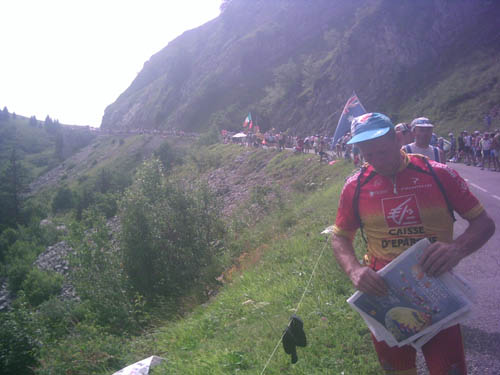
Our last day, no ride planned, just watching the ascent of Ventoux by the pro’s. Mike had made his Wiggo sign a couple of days ago, we rode to a fairly open part of the route so it might be seen by the helicopter cameras. We pinned it down to a grass bank with rocks, and settled down for a long long wait until the caravan, and then the first riders. Thousand after thousands of people passed by us on their way to the summit or higher vantage points. I saw later that the organisers claim half a million were on the slope that day. I wouldn’t be surprised. It seemed like all the world walked by. As soon as the last rider had gone by, we got on our bikes and picked our way through the people and cars to watch the finish of the stage on the big screen in Bedoin. We had to climb on top of dustbins to see, there were so many people there too. It was a great atmosphere. The applause and cheers as Schleck attacked again and again, Pelozotti too. The crowd really appreciated someone going for it. It was disappointing to see Wiggins keep dropping off the back, but at least he had a go and wasn’t far behind the more experienced road racers.
Waiting on the lower slopes of the Ventoux for the race to pass
We set off back to the car 7 km away as soon as the leaders finished, we had another TT burst on the way to blow the cobwebs out. As soon as we got to the car we got away from the area as soon as possible to miss the certain road chaos which would soon follow. It was bad enough when we left, in an hour or less it would have been impossible to move on the roads. We got onto the motorway roads and stopped at a parking area to cook our last meal and get changed ready for the long journey back to Blighty.
Dave Kirton, with Ian Tyerman and Rob Carter 108 miles, Bourg d’Oisans, Col du Glandon, Col du Telegraphe, Col du Galibier, Bourg d’Oisans, Alpe d’Huez.
After ten months of talking about the Marmotte after visiting the Alps last September, it’s finally arrived. We have spent more time talking about it than the event will probably take. How hard will it be? What training do we need to do? What gears do we need? And so on! Rob has read the reports and apparently the Marmotte is supposedly one of the hardest sportives in Europe. However, myself and Ian disagree. We have both said it’s just long steady climbing whereas our local sportives such as the Rydale Rumble and Richmond 5 Dales have much more difficult steep climbs. Now the talking’s all over and its time to answer the questions.
Thursday 2nd July
We had a long day getting to Alpe d’Huez, after a two hour delay at Leeds Bradford airport and some difficulty sorting the car hire at Geneva. We finally hit the road at 7 pm for the two hour something drive to the Alpe. Ian is the designated bus driver and we make it to Bourg for about 9.30 pm. Thinking that all the food in the hotel will be gone we quickly grab a tasty pizza in Bourg before driving up Alpe d’Huez. It appears much steeper and longer than we remember as we drive up in the dark. We find the hotel Chimony and get checked in. It’s a good little hotel. Rob’s done well booking it, £121 each for 3 nights, breakfast and evening meal.
Friday 3rd July. The day before.
Have you got any massive sprockets?
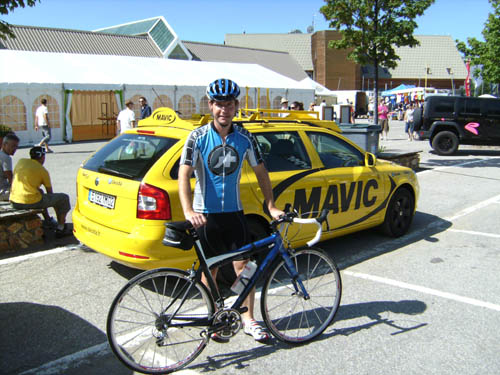
After a tricky nights sleep I wake up about 7.30. Looking out the window there are great views of the mountains and a ski lift going past. We get breakfast and then start getting the bikes together. We have a spin around the top of Alpe d’Huez to check the bikes and descend a couple of hairpins and back up. We are not fancying going right to the bottom and back up again like some riders. It’s then off to register and get our numbers, timing chip and goody bags. There’s loads of stalls selling all sorts of cycling equipment. There’s also a free Mavic service van and Ian asks them to take a look at his freehub body. They whip it off, oil it, check it over and have it running smoothly in about two minutes.
We head in to the sports centre to register. Rob’s in the queue for rider numbers 501 to 2000. Myself and Ian are in the 2001 to 4000 queue. Then there is the 4001 to 7000 queue! It doesn’t actually take too long to get sorted. Whilst waiting we get talking to several cyclists who have ridden it before. They all say that the hardest part is hitting Alpe d’Huez after already doing 100 miles over three large mountains, well that’s no surprise. Apparently there is usually carnage on the Alpe with riders collapsing all over, with some people reportedly taking two to three hours to climb the final 13 k. Great, I just hope it’s not us!
After we get sorted with the bikes and registration we head to the car to do a full recon. This maybe isn’t a good idea as the general opinion is that things usually look much more difficult from the car. I hope this is true as the climbs and descents all look difficult from the car and it takes over four hours just to drive round. We take all the scenery photos on the way as we don’t plan to be stopping and taking snapshots on the event day. On the evening before judgment day we make our final bike and equipment checks. There is a good meal laid on for us at 8 pm. I think they know that they just needed to serve up loads of good pasta and all the cyclists will quickly hoover it all up. It must be said that the food and hospitality in the English-run hotel is top drawer. The staff are even going to get up early and do us all a breakfast at 5.30 in the morning.
Whilst we are eating our lasagne Rob spots a blob of ice cream on a dessert as it goes past. He begins to worry that eating it will affect his performance! This gives me and Ian much source of amusement as we imagine Rob being destroyed on the Galibier as the small blob of ice cream does its worst. He soon changes his mind when it’s served up in front of him with a slice of apple pie, it disappears down his throat in seconds!
We head back up to the room for an early night. We do a lot of talking before we can try and go to sleep. I have difficulty concentrating on my report writing as Ian has just come up with an amazing assessment of the ride. I think what he’s been on about for the last ten minutes is breaking the ride down in to individual sections of average speed to come up with an overall average speed of 12 mph which would get us round in nine hours, not including stops! Me and Rob are both looking at him in amazement. Rob’s also still discussing his nutrition strategy and there’s still a lot of other unanswered questions. What will it be like at the start with so many riders? What pace should we set on the Glandon? Do we stop at the first feed station for water? Have we got low enough gears? To be honest I think were all quite worried. After all the talk, not finishing the ride just isn’t an option!
Sat 4th July. Judgement day.
The big day arrives. After hardly sleeping at all the alarm goes at 5.15 am and it’s time to spring into action. Despite the poor night’s sleep I actually feel o.k. we get straight down for breakfast, there is porridge, cereals, fruit and croissants, I also get some tea and coffee down my neck. Rob takes a few anxious looks back over his shoulder at the breakfast bar to make sure he hasn’t missed anything. We get back up to the room, get our gear on, get the bikes out and like a military style operation we’re ready to roll down the Alpe in no time at all.
I have arm and leg warmers on and a rain cape to descend down the Alpe. Luckily the weather is really good and it isn’t too cold dropping down. But we do need to carry all the warm clothes. If it starts to rain on the Galibier in the afternoon things could turn very cold, very quickly. Hopefully this won’t be necessary but as Ian has said “prepare for the worst and hope for the best” we found this a really good way to think about this ride when we were preparing for it and deciding what equipment to take.
I really enjoy the descent down to Bourg and I am buzzing despite the early start. Already we have passed several riders that have punctured before they have even started. We get into Bourg and filter in to our different lanes. Basically this is how it works. The road is barriered off into two lanes which are then split into a further two lanes to filter the cyclists into the correct holding areas. There is 0 to 2000 of which the first 500 are the top riders. Rob is 746 as he got his entry in early. Then there’s 2001 to 4000 which myself and Ian go into. I am 2094 and Ian’s 2025. Then the last lane is 4001 to 7000! I think they closed entries at 7000.
Anyhow me and Ian filter into our holding area and wish Rob good luck as he heads to his. To be honest Rob is better off riding his own ride. He is much stronger than either myself or Ian now and he has recently gained his second cat racing licence after only being fully in to cycling for three years, and despite his denials he’s probably going to attack the course. Whereas me and Ian are going to treat it like we’re cycling to Castleton tea shop and back half a dozen times.
The time ticks by and at 7 am it’s time for the first 2000 to roll out. They gradually start squeezing out over the start line and by half seven it’s time for our 2001 – 4000 group to go. We squeeze out onto the high street, one foot in the pedal as we paddle along with the other foot on the floor. As we approach the start line we manage to get both feet in and ride over the start line. There is a start mat that you ride over which registers the electronic timer (dibber) around your ankle. These timing mats are placed at various key points on the course. As we roll out there are crowds cheering and a brass band playing “when the saints go marching in” it’s a great atmosphere and very well organised. We were warned about how crowded the roads would be over the first few miles, but as the riders spill out over the start line they spread out nicely as they are gradually released.
The Col du Glandon. 1924 m.
We’re off! It’s 7.35 and we’re both sailing off down the road. A slight downhill seven km to the right turn which takes us over the Glandon. It’s great, just like a giant spread out club run with cyclists for miles in front and behind. Some take it easy, others nail it down the outside to gain places. Me and Ian just go with the flow.
We turn right up towards the Glandon which is confusingly also called the Col de la Croix de Fer depending upon which way you go over the top. I ask Ian if he is ready for the first of four appointments with pain. At this point we are still laughing! We climb up the side of the dam that the tour came down a year or so ago. It’s then flat for a couple of k, then we hit the base of the Glandon.
We had ridden the Glandon the previous year so we knew that it was more difficult than the profile suggests. It ramps up steeply for several k before levelling out, then there is a short descent then it ramps up again, before steadily climbing past more scenic lakes and dams to the top.
We set a steady pace as planned, but I begin to get irritable as riders continually pass us. We could easily stick on another one mph, but Ian talks me down and convinces me that we need to stick to the plan if we are to have anything left at the end. I can also hear the voice of Phil Meadows in my other ear with his talk about how he used to break his endurance running down in to steady blocks, and this way he would eventually catch up and overtake the runners that had set off faster. So with me brought back into line I let Ian get on with his controlled pace setting.
The top of the Glandon arrives quite nicely after 2.04 of riding. We’re both wondering where Rob might be now and I suggest we should have fitted him with a Rob cam! It’s mayhem at the feed station at the top. We had planned not to stop but we need enough water to make the descent and the long valley road before the next feed station at St Michel de Maurienne. We descend off the Glandon down to Saint Alban des Villards. It seemed like it would be a difficult and dangerous descent when we went down in the car, but on the bikes we flow down easily. I would rate us as average descenders but we seem to flow past other riders easily, even though we’re riding cautiously. It’s a long technical descent down and takes about 30 minutes to reach the bottom and my wrists feel like snapping as we hit the speed ramps going into the town.
We press on along the supposedly flat road towards St Michel de Maurienne and the base of the Telegraphe. The road is really heavy and its now getting towards 11am, the temperature is getting up towards 30 deg C. At one point I indicate to Ian to pull over. I’m convinced that my back brake has jammed on, but it’s fine, it’s just the false flat and heavy road taking its toll. We settle in to a good group and make it to the next feed station at the bottom of the Telegraphe. There’s more mayhem at the feed station as we grab water and prepare for the ascent of the Telegraphe.
The Telegraphe. 1570 m.
Col du Telegraphe
The Col du Telegraphe is supposedly the easier of today’s four climbs. Just a warm up before the Galibier! We climb up steadily. Ian’s setting the pace again, but with the heat and the continuous gradient starting to take its toll the Telegraphe starts to sap our energy reserves. Anyhow we manage a good pace, doing the 12 k to the top in just under an hour. We seem to be starting to pass many riders on the way up that are beginning to have difficulty with the conditions. I take time to look over the edge at the sheer drops down to the town below. It’s like taking off in a slow aeroplane, then I get back to focusing on Ian’s pace setting. It’s interesting watching other people’s styles. Stronger riders pass us and disappear, others seem to repeatedly sprint past and then go back over which seems a waste of energy, whilst others simply go back over. The other funny thing I have noticed is that there’s no talking? It’s like a slow silent race. Everyone is in their own little world of concentration.
We reach the top at 1570 m. There’s another feed station and we top up with supplies again. There’s less mayhem this time. The Telegraphe has been a steady gradient over an hour but with the heat it’s started to take its toll on both of us. It’s a pleasant descent of 5 k to Valloire. Now it’s time for the biggey.
The Col du Galibier. 2642 m.
Dave on the Galibier wonders when it’s going to start getting tough
As we climb out of Valloire the sign says Col du Galibier 17 k, great! Now this climb didn’t seem too steep when we went up in the car and we had cycled up from the Col du Lautaret side last year and it was o.k. but as we drag up, the length of the climb combined with the heat and 60 miles already in our legs starts to take its toll. We seem to be steadily passing riders again but as we hit the 10 k to go, we both start to get in to difficulty. Ian suggests I ride on by myself as he’s suffering, but after a couple more k I have to let Ian go as I suddenly begin to feel sick and my power is failing. I arrange to meet Ian off the descent at the other side of the Galibier, top of the Lautaret. With about 5 k to go I’m in real difficulty. My legs have gone and I feel like I just want to get off and throw up. Ian later tells me he felt the same on Alpe d’Huez and a lot of other riders are looking in similar condition. We believe it’s due to trying to get all the food and energy drink down in such heat. Anyhow I decide I’d rather plod on slowly than stop. I endure one of the most torturous 45 minutes on the bike ever as I creep up this massive mountain at 4.5 mph.
Even though I feel bad I try to take in the breathtaking scenery. There’s a thunder storm rumbling over the mountains behind, I just hope I make it over the top before it hits. As I look down to the valley below there’s still along line of cyclists all the way down. I’m just glad I’m not back down there. I try not to look up as there’s still several hairpins to go towering above me. There’s a continues stream of riders passing me. I’m really disappointed as it starts to look like my ride might be over. I have to pull on all my cycling experience and will power but eventually haul myself over the top. At the top I roll straight over and descend down to the Lautaret. Ian has been there about seven or eight minutes he says and hasn’t had the greatest time either. I get off the bike and go behind a car to be sick. Ian points out that there’s a family nearby trying to have a picnic. I hope I haven’t spoilt their dessert! Does this paint a lovely picture of the Galibier!
I thought at this point my ride was over and tell Ian to press on as I put my emergency recovery plan in to action. I have five minutes rest and stock up with a bottle of water and another of energy drink. Now the descent off the Lautaret is a long steady one for about 25 miles back to Bourg with just a few smaller rises towards the end. So I steadily descend down, constantly sipping water. I pass riders again on the steeper part of the descent and after a while I get on to the back of a good group and my stomach begins to settle down. I start to gradually load up with gels and flap jacks, nibbling continually until we reach Bourg. I even do some turns on the front as my power seems to miraculously come back on. Hopefully that’s my bad spell over. But what a fine place to have a bad spell on the mighty Galibier.
Alpe d’Huez. 1880 m.
Alpe d’Huez, hairpin 4
I arrive at last at the base of Alpe d’Huez. Reports later said it was 38 deg C at the bottom. I feel o.k. now the engine room has switched the power back on. I get stocked up with two bottles of water at the feed station. My plan is to steadily spin up the Alpe and most importantly keep cool by pouring water over my head. I settle in to a reasonable pace keeping up 6 mph. The longest steepest section is from the bottom to the first hairpin 21, “where Sastre attacked last year” I get to there and start counting down. I’m passing riders again and just keep drinking the water then pouring some over my head which feels great. Lots of riders are stopping and cooling themselves in the waterfalls that come down the sides of the cliffs, other riders are getting off and lying down. I would rather just keep plodding on. I get extra water handed out by supporters at the side of the road and I pour most of it over my head.
I make good progress as the hairpins tick away and Bourg d’Oisans begins to look like a toy town below. I get to about 4 k to go and after my good spell my legs start to fail again as I have been climbing the Alpe for an hour. But look who’s ahead! There’s Ian at the side of the road. He’s off his bike and looking like he’s going to throw it over the edge. It’s Ian’s turn for a bad spell and he said he just had to get off for a minute as he has had enough of riding his bike. He climbs back on the bike and we both struggle the final 4 k to the top. It takes another 20 minutes or so to complete the final push to the top. Every pedal turn becomes more difficult. We pass many riders in much worse states or passed out at the side of the road. It’s Alpe d’Huez carnage in the heat. As the road levels off at the top the finish line looms into sight. We crawl over the finish line, it’s such a relief to finally stop pedalling. We both collapse on top of the bars and say never again! As we move through the finishing area there’s Rob looking fresh as a daisy. He shouts are you both alright, I reply we’re far from alright Rob. My legs start to lock up as I walk with my bike like John Wayne. Me and Ian have completed it in 9hrs 27 mins. Just 37 minutes outside the gold time of 8.50, so respectable I think. In fact Ian’s calculations of 12 mph were not far out as I register 12.2 mph average on my computer. But get this, Rob’s finished in 7 hrs 36 mins! We knew he would go well but didn’t think he would get round that fast. The winning time is 6.09 by a rider called Bart Dekker. But Rob’s finished number 335, up with the top riders. Rob takes our timers for us and exchanges them for certificates and Marmotte water bottles. That’s all you get for the efforts. No free T shirts and medals are ten euros. We get back on the bikes to ride the 500 m back to the hotel but I can’t actually do one more pedal revolution as the back of my legs have locked up. Back at the hotel I climb the three flights of stairs with great difficulty. We get showered off and collapse on the beds. It’s been a real long day!
Later on.
After an hour or so of recovery I persuade Ian and Rob that it would be good to take a walk out on to the Alpe to stretch our legs and watch the stragglers coming in. Some riders will take 12-13 hours to finish. There’s actually a cut off time of 6 pm at the bottom of the Alpe where they will take your timer off you which seems a bit cruel.
Its half six and there’s still a steady stream of riders making the last bend. We give them a big shout as they go past. We have a lot of respect for these riders. Anyone who has made it has done well. At this point a rider comes by and I have to look twice in amazement. We all can’t believe it, I’m not kidding he’s got one arm and one leg! We’re awe struck. Now that guy deserves a free medal. It must be hard enough on the climbs but imagine him on the descents! Back at the hotel we shove down our tea. But then our big drinking session we planned on Alpe d’Huez turns in to two small bottles of beer. That’s all we can manage as w’ere just too knackered.
That’s it, it’s all over. We pack the bikes the next morning and drive down the Alpe, stopping half way down to watch some of the riders that are time trialling up in an event called the Grimp. Most of these riders will have done the Marmotte yesterday. Some people really like their punishment! We drive away from the Alpe back to Geneva, and despite saying that I would never do it again we find ourselves already talking about how we could improve and the possibility of riding next year. Aren’t cyclists stupid!
After thoughts.
The Marmotte has been a spectacular event and very well organised. There were no problems at all with the number of riders at the start. And the instructions were all clear and easy to follow. The feed stations, although hectic, did very well to cope with the volume of riders. The route itself was spectacular if you took time to look around, but it was extremely challenging. The heat was a big factor, but equally it could have been really cold as in previous years. I’m just glad I did lots of long training rides for it otherwise that bad spell on the Galibier might have been the end of it. In answer to our earlier question, yes it is more difficult than our local sportives and I’m sure that it probably is one of the hardest in Europe. Although the climbs aren’t really steep it’s the sheer length of them. Out of the 9 hrs 27 min of riding I reckon that nearly six hours of it was climbing, or in terms of distance we’re looking at M’bro nearly to Scarborough uphill. Frightening if you think about it too much.
The only thing we did get wrong was the gearing. I had a compact on, 34/25 and Ian and Rob had 38/27s which is nearly as low. These gears were fine in the Alps last year over shorter distances. But we could all have done with a lower emergency gear. Lots off the real good riders that past us had what looked like 34/27s on. From what Rob was telling us the top riders nail it round much faster but then just stick it in to the 27 and spin up Alpe d’Huez. The annoying thing is that I have a new set of 12/27 Ultegra sprockets in the garage! But I decided not to put them on. What a dummy.
Well I think it’s been well worth the efforts. Now I’m going to do some armchair cycling in front of the TV for the rest of July watching the tour. Then I’m going to retire to Castleton tea shop all winter before one of us comes up with the next stupid idea!





 Cleveland Wheelers