Categories
Article

The Fred Whitton

It had just gone 7am as I looked out of the window of the climbing hut, the valley was enveloped in low grey cloud and it was raining, if not heavily but persistently. A typical Lakes day then, one where it is hard to imagine it ever being dry again, yet you irrationally hope will clear quickly.

Now it was 8.30am and the start time loomed, the rain had become heavier and was bouncing off the floor, a few last minute checks on equipment and visits to the toilet only delayed the inevitable, we simply had to get going. Time to introduce you to the cast:

Waiting to start in Patterdale, left to right Paul, John P, Mick, Dave, John K is taking the photo. It’s actually raining quite hard despite the smiles.

John Kelly. John is a keen cyclist and club run regular and while enjoying the odd climb in moderation it is fair to say that he felt that this ride included too much of a good thing. John very generously offered to be our team car/broom wagon/soigneur/mechanic for the day. We all hoped that he would master the art of the ‘sticky bottle’ and ‘magic spanner’ as the day went on. The ride would have been really difficult without him. Oh and he also narrowly beat Mick in Dave Kirton’s Best Snorer competition the night before the ride.

Dave Kirton. Judge of the Best Snorer competition, owner of the biggest rear sprocket, a 32! And eternal optimist. Completer of two Marmottes, Dave likes to see himself as a strange mixture of propulsion devices: a powerful diesel when he’s churning along undulating roads, he ‘gets the turbine going’ when he winds up the pace, but as he nears his limit he ‘lights up his boilers’ and on rare occasions when he nears collapse ‘the dashboard warning lights will come on’. Dave is also a man who likes a sandwich or rather a small suitcase full and generally a good man to have around.

Mick Rennison. Mick is infamous for his lack of bike maintenance and as you ride with him expect bits from his bike to gradually loosen themselves before rolling down the road. Despite admitting that hills are not exactly his strength (Mick prefers to focus on developing his formidable sprint) he was going to ride round this on a normal chainset until I scared him with horror stories of Hardknott. Mick would also become our unofficial Weatherman for the day.

John Price. Paris Brest Paris finisher (1,200 km) and veteran of other numerous long distance Audax events, as well as a vast experience of long distance fell running and rock climbing, John was my banker to get round this come what may. It worried me a little therefore when the night before he told me that this ride worried him, mainly due to the severity of the climbs.

Paul Christon. That’s me, solid cyclist and fell runner, I along with John P had the disadvantage of knowing the Lakes really well and more or less every inch of the route. In a cycling sense I suppose hills are my strength but in the grand scheme of things that doesn’t mean an awful lot!

A mention must also go to Ian Jones who was hoping to do the ride with us but unfortunately had to pull out. Ian had done much of the preparation rides with us including a ride up Rosedale Chimney. A bit of a mountain goat I’m sure that Ian would have got round. As the saying goes ‘the hills will always be there’.

It is now 11 am and it is still raining despite numerous hopeful comments by us all, but mainly Mick, saying that it was about to clear. I am feeling rather sorry for myself as I freewheel down the beautiful Newlands Valley. My attempts to recover from a cold haven’t been helped by forgetting my waterproof cycling jacket so I’m wet, cold and considering slipping into our Broom Wagon. More worryingly John Price, of all people, has just told me that he’s not feeling too great, are we going to get round?

As planned we had set off in the rain just after 8.30 from Patterdale rather than the traditional Coniston start point. Being a circular route and with our accommodation being right on the route we felt that this made sense. For those of you not familiar with it the Fred Whitton is an 112 mile sportive event that is run in the memory of the man himself who died in 1998. It takes in the six big Lakeland passes – Honister, Newlands, Whinlatter, Hardknott, Wrynose and Kirkstone as well as six other tough climbs. We had thought about entering the official sportive event but it is massively oversubscribed so we may not have all got in. So as an alternative we came up with the idea of taking to Wheelers’ Club Run on Tour. The first challenge of the day was the drag up to Matterdale End, a steady climb of around 5-6% this was a gentle introduction to what lay ahead. We all eased ourselves up this before taking it steady down towards the A66 and then Keswick. We had decided beforehand to take the sections between the climbs really easy and enjoy the route rather than press on for a quick time.

The bit down Borrowdale started with Mick’s computer unseating itself and flying off down the road. As we approached Honister it was… well wet… very wet and is best summed up by this quote from John P afterwards:

‘Riding down Borrowdale Mick our team meteorologist declared, “that’s it, the rain’s over”. Since at the time we were approaching Seathwaite (wettest place in England at 126 inches per year) I thought Mick was being a bit optimistic. Five minutes later the cardboard peak on my cap started dissolving in another downpour of biblical proportions. All this while I’m trying to winch myself up Honister Pass’.

Honister is a brute, from either side, but from the Borrowdale side it starts really steep at 25% before easing then kicking up again right at the end. Bearing this in mind and what was to come later I decided to employ my bottom gear of 34×29 and try to get up as easily as possible, which still hurts by the way. Another problem we had was the fact that it was wet which meant that as soon as you got out of the saddle the rear wheel slipped or had ‘Major Traction Problems’ as Dave called it. I rode up with Dave and we both nearly came off due to this before realising that you had to stay seated.

By this stage I was already soaked and my hands were cold and barely able to feel the bars never mind the brakes on the descent. I was really glad get down in one piece and to see John K waiting for us at the bottom. Here I decided to change into full finger gloves and another dry but unfortunately not waterproof jacket. Dave later admitted that he was getting concerned about my condition at this point. After taking on board some fluid we were off towards Newlands which follows Honister more or less immediately.

Newlands is, rather surprisingly in my view, not mentioned that often as a serious climb, but believe me when I say that it is. Kicking up from Buttermere it then levels off before kicking up viciously all the way to the top. Only a small ease in the gradient before the final 25% section makes it anything other than a fight for survival. John and myself had done this before and we both felt it was as difficult as Honister from Seathwaite. The descent down the Newlands Valley from the top of the Newlands Pass is normally one of the most enjoyable bits of road in the land. Today though it was wet and I was cold and this was the point which I talked about earlier where I honestly thought about the Broom Wagon.

At the end of the Newlands Valley we reached the lovely village of Braithwaite and the climb of Whinlatter starts straight out of the village. Different in character to the previous climbs as it is wooded throughout Whinlatter is a long climb rather than severe but still has some steep sections in it. I really enjoyed this climb as it was the first time for about two hours where I hadn’t felt anything other than freezing cold. Having the lower gear fitted really came into its own on this climb as by spinning it was possible to save the legs for the horrors that were yet to come. As we were greeted by John K at Whinlatter summit it was a turning point for me. I was warmer, though still wet, and the legs felt okay. The weather finally looked to be turning and John K informed me that he had heard a weather forecast and the expected better weather for the afternoon had been confirmed.

I wasn’t the only one feeling this way, again John P takes up the story:

‘I struggled until after Whinlatter. However, after that point I remember I resorted to the most up to date, scientific nutrition available to the competitive cyclist. A pork pie. Strangely enough all went well after that. I know I said I was going to shoot myself in the legs but actually I’d decided just to break my toes instead’.

So we all set off for the long section heading towards the western lakes and the Hardknott/Wrynose ‘challenge’ that lay before us. Only John P and I knew this area, possibly a disadvantage, but also knew that the section to get us there should not be underestimated. Although there is no really big climb there are four testing climbs plus some heavy rolling exposed roads, so thinking too far ahead can be counterproductive.

Easier said than done though isn’t it. Ever since I’d organised this event, well I say organised what I really mean is roughly pulled it together with a few emails and casual conversations, the main thing I’d been thinking about was Hardknott. I’ve stayed at Eskdale Green many times and driven over it and walked over it more times than I can remember. ‘How bad is it?’ Dave asked me a few times. ‘Really bad, imagine Rosedale Chimney but twice the length and a more difficult road surface and you’re about there. You know when you see a road as you approach it and it looks awful and when you actually get there it’s hard but not as hard at it looked? Well when you see Hardknott it is as bad as it looks, worse even’. These sort of conversations obviously scared Dave as about a week before the ride he informed me that there was no way he was going to walk up it and proudly showed my the new members of his family, a shiny healthy set of sprockets, the biggest of which had 32 teeth! Overkill I thought at the time, yet as we made our way towards the next climb of Fangs Brow I couldn’t help but look on with envy as he twiddled along with all his fancy low gears.

Fangs Brow is a sharp little climb, the sort of thing you typically find lurking hidden away on the North York Moors. Not long after this you do the less steep but longer climb of Kelton Fell. Neither are particularly difficult but they all take a little bit out of you. It’s an attritional ride where conserving energy is key, particularly if you want to get up the climbs towards the end of the ride. Saying all this after a café stop at Ennerdale Bridge at 56 miles I hit a definite low point. I wish I could have blamed Mick’s flap jacks but I politely declined one despite the tempting offer as he passed round the open box ‘would you like a flap jack, they’re not very nice’ he said in a very matter of fact way.

In the meantime John P had pressed on preferring not to stop and we arranged to meet him at Boot just before Hardknott. Unlike me John was getting to grips with the latter part of this section:

‘The western leg after Honister to Gosforth seemed to drag but the next section into Eskdale was great. Sunshine, fabulous scenery and although Irton Pike was a bit of a graunch I really enjoyed that part of the ride’.

Straight after Ennerdale Bridge we began the climb over Cold Fell. I knew this road, it is steep to start with and then drags on over the top of the fell for quite some time. It is not really typical of the Lakes in its character, feeling in some respects more like the North York Moors, and it is very exposed. Mick and Dave were going quite strongly at this point and I found myself having to work a little harder than I would have liked to just to stay on the wheel. I felt like this all the way until the Irton Pike climb just before Eskdale Green. This is a tough little climb, probably around 10% to start with before levelling off, in some respects like a miniature Whinlatter. I began to get worried about my prospects for Hardknott judging by how poor I felt.
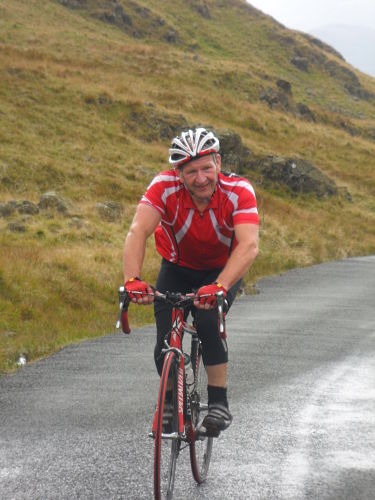
Mick at the top of Hardknott

After the descent and the run through the picturesque village of Eskdale Green we approached the turn off towards Boot and the warning sign for Hardknott and its 30% gradients. We met John K and John P at Boot and looked nervously down the road that would take us towards the crux of the route. Mick and John P set off a little ahead of me and Dave. I then decided to stop for a ‘natural break’ leaving Dave to ride on. This was a situation that neither of us was unhappy with I suspect as climbing this was the one thing on the route that was going to be an individual affair, Man against Hill.

So here we go. I had imagined climbing this hill for many years, imagined riding smoothly up in triumph, imagined struggling manfully against the slope before collapsing heroically at the summit, but also I’d imagined gradually grinding to a halt before falling off in a heap. What was it to be? Well none of these really. I knew that the first bit was super steep but thought it would be a bit easier than it was. Right at the bottom I went straight into my lowest gear and literally thought just one turn at a time. It was by now dry (at least on this side of the pass) so getting out of the saddle was thankfully an option. It really is just a case of grinding up negotiating as best you can the tight bends and the poor surface. I came up alongside John and Mick similarly battling away, although they were disadvantaged by their 26 and 27 biggest sprockets, we mumbled some brief encouragement to one another. Getting to the top of this, just the first section, is harder than anything else on the route, harder than Honister, harder than Newlands and is probably as hard as Rosedale Chimney Bank. I just focused on getting to the top of this while trying to push the top section to the back of my mind, trying… problem is as soon as you finish the bottom section the top section comes into view ‘Oh S***!’

If the first section was harder than I though then thankfully the middle section linking it to the top section is easier than I expected. It still goes up but if you have a small gear you can recover a bit, just take this as easy as you can. I could see Dave up ahead approaching the top section, he looked to be going really easy in his 34×32 gear, I cursed him. What can you say about the top section other than it really is survival. At one point as I approached the first really steep bit Dave was going up a ramp that swings to the left. I could see this side on and the angle looked totally ridiculous, what’s more he was in the saddle whereas before he seemed to be riding mainly out of the saddle. ‘Why?’ I thought. A minute of two later when I got there I could understand why, there was water running down the road. Getting out of the saddle would almost certainly mean wheel slip or ‘Major Traction Problems’ and coming off. This is the steepest section of the climb and was followed by another steep section to the right, it’s as much as you can do to keep moving. Eventually you get to flatter ground, probably around 15%! then providing you aren’t in a state of collapse you know you’ve done it. Dave was wheeling back down a short way from the summit towards John K who was taking photos ‘the top’s just up there’ Dave said pointing to it, if I’d had any breath available I’d have said ‘really is it? I was just about to stop right here thinking I’d done it’ I know he was trying to be helpful but I was knackered you understand. When I joined Dave and John K Dave said ‘10’ this was a reference to the ratings that we’d been doing for the climbs on the North York Moors for the club website. He’d given the Chimney only a 9 and I’d asked him what he’d give a 10 to, well this was the answer, fair enough. John P came up not long afterwards having climbed the second section but having to stop briefly at the top of the first, and then Mick who vowed to return with lower gears and conquer it, knowing Mick’s level of determination I wouldn’t doubt it.

John P neatly describes his ride from Boot onwards:

‘Something strange happened after that (the stop at Boot), a sort of Thomas Voeckler on the top of the Galibier moment. Except I looked like that for about 35 minutes. Sitting down in a cafe at Coniston was a high point and the remainder just sort of happened. However, I thought the road to Troutbeck was as hard as Kirkstone’.

Hardknott Conquered! I’m asking Dave if he’s really giving it a 10
John ‘winching’ his way up Hardknott this time!

So you’ve got up Hardknott job done? Think again. First you’ve got to get down the other side. In the dry I imagine that this is really difficult, it was still wet when we did it and it really is a brakes full on job for much of it. Being weedy cyclists with little upper body strength (well at least in the case of me and Dave) this along with all the other braking required on the route is a full body workout! Then there is Wrynose, no where near as hard as Hardknott but it nearly did for me. I opted to go up Hardknott as light as possible with only half a bottle of fluid and forgot to top up before setting off again. I’d lost fluid by sweating on the way up as it was now the hottest it had been all day and this coupled with general fatigue meant that I was seeing stars going up Wrynose which in itself is a steep climb and long enough, even from this the easier side, to tip you over. I pressed on the pedals but couldn’t really feel anything, it was weird, and I thought I was going to have to get off. I just kept going and we regrouped at the top. I borrowed a bit of drink off Dave and we headed for Coniston our next meeting point. The descent off Wrynose is another to test your brakes and bike handling and then even the rolling roads to Coniston itself is hard work. Normally this would be the end of the route of course, but for us we still had two climbs and around 25 miles to go. By the time we got to Coniston I was on empty and was quite pleased when the consensus of opinion was that we should stop for Coffee. By this time the sight of John Kelly opening up the boot of the car was the best thing in the world; I was hungry and had been day dreaming for the past hour about the sandwiches stashed away in my bait box.

Nearly there…

Hawkshead Hill just outside Coniston is a really nice ascent, twisting up through a wooded area at a fairly constant gradient of somewhere around 6-8%. Despite topping up my food and fluid I still didn’t have much in the legs while Dave flew up this climb, now all I was thinking of was getting to the bottom of the final climb of Kirkstone.
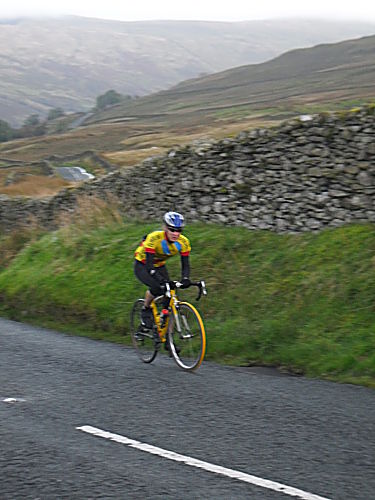
Paul nearing the Top of Kirkstone ‘Where’s that bloody Inn?’

Before that though there was a nasty little surprise, it went up Holbeck Lane to Troutbeck. This was quite steep in places, perhaps up to 12%, and goes on for quite a while, the gradient varying all the time. Strangely enough I actually started to feel a little better on this climb. Eventually the road drops a little and joins Kirkstone part of the way up. Now it was just a case of going up until you reach the inn at the top. The climb is a strange mixture of short steep ramps of around 10-15% followed by short flatter sections and I just settled for selecting a low gear, finding a rhythm and getting to the top, as did John P and Mick, Dave preferring to let it all out from about a mile out to the summit and quite fittingly I thought, the highest point of the ride. Then it was just a case of the wonderful descent from the mist at the top to the sun in the valley below. We all grouped together for the final run in. 112 miles and 3,800 metres of climbing in around 10 leisurely hours with a ride time of 7.52, job done!
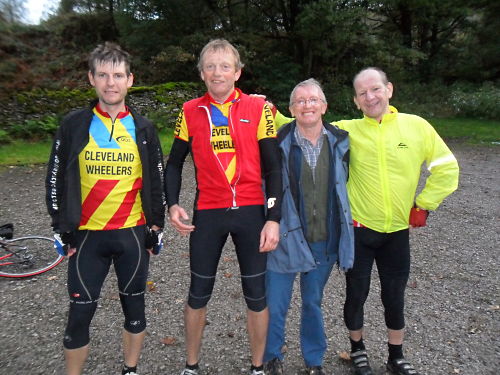
Back in Patterdale, Dave is on the left (complete with helmet hair), John P, John K and Mick on the right with me taking the photo.

You’ve read my ups and down of the day, but on the whole it was the most enjoyable day on the bike I’ve ever had. Here’s what the others thought:

Mike :

‘It was a great day even if a long one. I must agree with all your scores (see below for the hill ratings). My two walking efforts on Hardknott and Wrynose, these were too steep for me with a lot of miles in the legs, Honister and Newlands were as steep in places I thought I scraped over them cos the legs were a bit fresher then. I had a little bad spot about a mile off the top of Kirkstone Pass where I stopped and had yet another little stroll to get my legs working again, then I was fine and will be out today, Monday, for a couple of hours on the bike. The flap jacks offer was funny because when you’re tired you say the wrong things, “would you like one they’re not very nice “I also think the route is the most scenic one I’ve been round so that must score a 10 and is a must to do . The views on route more than make up for the pain of all the hills and I enjoyed the finish, a big thanks to John for the back up drive thanks again John. I would do it again but this time with a dinner plate on the back, it was great.

John P :

‘Great day. I’m really chuffed I managed it. Many, many thanks to John for the support because I think that made all the difference. Now about thoughts of the day – where do I start? I reckon Honister Pass was the second worst, hard and serious with an evil downhill section as well. Anyway, Sunday, when I managed to pull myself out of bed and remembering the out of body experience on Hardknott I decided to count the number of teeth on the big sprocket. One member of the team (big girl’s blouse) had 32. What did I have? I don’t know whether I should admit to this because it’s really, really stupid of me – there were 26. Anyone reading this ramble – don’t ever make the same mistake.

Dave :

‘Memories of ride. John Kelly’s snoring. My creaking bike rack. Finding the toilet in the dark. Telling u all that Rob Carter doesn’t think we will make it made us determined. Looking like mad men setting off in rain. Cold start, I was concerned about your condition. The miles seemed to clock up quickly, think its cos we weren’t concerned with time. Did Mike say the rain’s definitely stopping this time? Mike’s flap jacks! Mike’s gritty climbing ability. Mike’s bar tape. John’s plodding on strategy. Me and Mike following blindly hoping you and John knew the way. Forearms aching more than legs on descents. Balancing act over handlebars on Hardknott to prevent wheelying. Telling John Kelly that I’d just done brakes on my car myself and that they should be o.k! (John was driving Dave’s car on the route). You seeing stars on Wrynose. Cafe stop at Coniston we’re all going to make it easy now with 22 to go. Views over Windermere and sun set. Difficulties on Kirkstone everyone starting to blow. Fast descent to finish. For some reason Mike didn’t want to sprint. 10hrs 1min. call it 10. We are all chuffed to bits to all make it round as a group, changed and recovery tights on, 12 inch pizza when I get home.

John K :

There was one point in the ride which made a lasting impression on me. It was when I was stopped in the valley between Hardknott and Wrynose. I could see you all climbing up to the top of Wrynose and the road from that distance seemed almost perpendicular, so much so that the feeling was you could start to slide down backwards if you weren’t too careful. That may now sound a bit fanciful but that’s what struck me at the time. Other things also come to mind – the dreadful conditions at the start, the kind of morning where if you’d been at home you wouldn’t have gone out but gone back to bed instead. The water cascading over the road on the Honister Pass. Me trying to warn you and coming to the conclusion that mobiles are a waste of time in the Lakes. Wringing water out of clothes at Buttermere and everyone feeling a bit despondent. The weather beginning to turn for the better at Whinlatter and a corresponding change in mood. John Price scoffing his pork pie at Boot before the big push up Hardknott. I don’t know why but a pork pie at that juncture seemed a bit incongruous, perhaps it’s the staple of the Audax crowd. Dave appearing approaching the top of Hardknott muttering something like “I couldn’t have got up here without the 32 on”. The feeling that the worst was over in the cafe at Coniston. Then the big sting in the tail consisting of Hawkshead Hill, Troutbeck and Kirkstone Pass. Troutbeck especially seemed to go on for ever.

Doing the Ride

Probably the easiest way to do the ride is to enter the Sportive itself, if you can get in that is. Otherwise you can officially enter through the Four Seasons option registering at Coniston, details are on the site http://www.fredwhittonchallenge.org.uk/index.php along with the route, profile and loads of other useful information. Or like us you could start at any point on the route. The route itself is very obvious in some areas but not in others so it does help to carry a map if you don’t know the area.

You’ve read about our choices of gears and how we fared, it really depends how well you climb and how heavy you are but Hardknott is going to be difficult whatever gears you have. Don’t forget bike handling too, we have all been riding bikes for years but we still found coming down Hardknott and Wrynose in the wet extremely difficult. It is the Lakes so prepare for anything and don’t forget your waterproof jacket like I did, it nearly cost me dear. On the whole though I would say that any reasonably fit cyclist could get round as long as you’re not pushing it, we’ve all done century rides before, and much longer in some cases, but pushing the pace on a course like this is flirting with danger. One other advantage we had was John K in the support car, we all agreed this made things a whole lot easier, especially as we didn’t have to carry loads of food and drink from the outset and it’s comforting to know that we had some options if someone got ill/had a crash/had a major mechanical.

Facts and Figures

As we’ve been rating the climbs in our area (see Killer Climbs on the website) Dave and myself thought it might be interesting for us to rate these climbs for anyone who’s thinking of doing the route or the sportive. These are in the order that we did them. Dave always marks hard so take this into account, he reminds me of my teachers at school!

Climb Ratings
Climb High Point (ft) Paul’s score Paul’s comment Dave’s score Dave’s comment
Matterdale End 1,125 4 long and steady 2
Honister Pass 1,167 9 Vicious start! 9 Major traction problems
Newlands Pass 1,092 9 vicious end! 7
Whinlatter 1,043 7 Long 5 Alpine style climb
Fangs Brow 721 5 Steep ramps 4
Kelton Fell 837 3 Easiest on route 3
Cold Fell 968 6 Starts steep then drags on, where does it finish? 5
Irton Pike 357 5 Winds up through the woods 3
Hardknott Pass 1,289 10.5! Bonkers! 10 The hardest hill I’ve ever done in the U.K. as well as strength good bike control also required. I don’t think I would have made it without 34×32 gear ratio. It’s awesome. Even car drivers move out the way and wave at you in respect. Remember my reaction at the top, I just said 10!
Wrynose Pass 1,289 8 It felt like a 10 to me at the time, but I think it was because I was having a minor meltdown! 8 A real difficult final 100m especially after Hardknott
Hawkshead Hill 646 5 Great surface, lovely sweeping bends just wish I’d felt better at this point! 4 A really nice climb with switchbacks, I really enjoyed opening the throttle on that one, always feel good after cafe stop
Holbeck Lane 640 4/5 Watch out for this one! 6
Kirkstone Pass 1,489 7 The Kirkstone Inn will appear eventually, honestly! 7 Is more difficult than it should be with over 100 miles in legs, lots of nasty little ramps. Cracking descent down to the finish though

Paul Christon – October 2011

Categories
Article

Cleveland Wheelers at the Stockton Triathlon

A couple of months ago at the Evening Series Dave Kirton and myself were throwing around the idea of entering a Cleveland Wheelers team at the relay event at the Stockton Triathlon. Problem was finding a swimmer as Dave opted for the cycle leg and fearing drowning I volunteered for the 10k run. Step forward Neil Mentier and so he became the final piece of The Iron Kirtons – that’s the name you end up with if you put Dave in charge of the entry! However I have to say it’s a name that we’ve all become fond of.

Fast forward to the day of the event itself and I am looking on quite concerned as Dave tries to extract his keys from his car seat. We haven’t set off yet and he’s somehow managed to get them jammed down the back of the seat and I’m worried that he’s going to start dismantling it. If it was anyone else I would be unconcerned but I’m reminded of an incident in the Spring where he locked our bikes to a metal fence while we went for a tea stop in a cafe. After half an hour of trying to find the right combination to free the lock he had to resort to a trip around the retailers of Stokesley in a search for some cable cutters. No such problems today though as he wrestles the keys free and soon we’re on our way.

The event has a great feel to it, decent crowds, a DJ/commentator and tension. Yes tension, I think we’re all a bit anxious that if we ‘muck up’ it won’t be only our own race ruined. We’ve also got our wives there and a collection of friends and family to cheer us on, and a great job they did too, but it all adds to the pressure. The day before Dave had been sending me and Neil a series of texts with short messages such as ‘tomorrow it’s judgement day!’ which seem to have affected him more than us. He was a man on the edge, living on his adrenalin, fearful of a puncture, a transition violation of some sort, of not being able to warm up, all sorts of things in fact. The reality was I had the easiest job. Neil would be up against all the other athletes while they were full of energy, nervous and physical, Dave would have to weave his way through a very twisting, technical bike route and had potential mechanical issues to think about. For Dave it was also his first multi discipline event whereas Neil had done Triathlons before and I had done an awful lot of Duathlon (run/bike/run) events until about three years ago. So all I had to do was run, I didn’t even have to get out of my cycling shoes into my running shoes to do it and I would be up against other athletes who, in the main, had already done a 1,500 metre swim and a 40k bike.

Also there on the day were Cleveland Wheelers John Kettle, Joe Foley, Sandra Main, Tony Main doing a solid job marshalling, while Kay Stokes was winning her age category in the full event, and Kath Blakey was doing likewise in the sprint event. Good performances were also being put in by club members Stefan and Kevin McLoughlin in the sprint, with son narrowly edging out father, while other CW members John McGuigan and Rebecca Kirton were cheering us all on. A great turnout for the club!

Neil was up first up for the team and as he lowered himself into the cold waters of the Tees I didn’t envy the task ahead of him. The tension steadily built and then the hooter went off signalling the start of the race. We cheered him on but to be honest it’s difficult picking out a swimmer when all you can see is their head, which has the same colour cap on as nearly all the other swimmers. The distance that he had to swim seemed huge and made me realise that I will probably never be able to complete a full distance triathlon, especially with an open water swim. He came out of the water bang on the 25 minutes he’d estimated, the Iron Kirtons were on track, but for what? Normally in transition an athlete has many things to contend with, fatigue, falling over, forgetting to put your helmet on, struggling to get your footwear off and on etc. All we had to do was simply exchange the timing band from one athlete’s ankle to the other. Soon Dave was off and carving through the field, as we watched it was clear that he was going quickly but as there were also competitors from the sprint event and lapped athletes intertwined with Dave’s progress and knowing where we were placed wouldn’t become apparent until the second transition.

I was waiting in transition talking to the other runners from the relay teams when Dave came in, inside the top 20 overall and possibly, I thought at the time, second out of the teams. As Dave wheeled his bike up towards our spot for racking the bike where I was waiting something seemed to have happened to him. Out on the circuit somewhere someone had replaced his legs with solid wooden stumps, he was moving about, but didn’t seem to be getting any nearer. ‘Come on!’ I urged, when he got there he groaned that there was no way he could do a run as he’d cramped up ‘you don’t have to I’m doing it’, I said as we hurriedly got the strap onto my ankle. Dave had done a ride of around 63 minutes, a great time on a very twisty track in windy conditions.

The standard of running in triathlons is sometimes scarily quick so I figured that if I maintained our position I would be happy with it and after around 10 minutes of running I’d passed someone but had also been passed by another athlete who seemed to be running around 35-36 minute pace, too quick for me, so I decided not to follow. The athletes on the run were quite spaced out and the route was very intricate so you couldn’t always see the athlete just in front and now it was my turn to get nervous. I took a wrong turn at one point, probably costing us only 5 seconds or so, but I started to worry that I might also cost us a good overall result. It was a relief to complete the first of the two 5K laps and the time was around 19.20 which was also a relief as there were no kilometre markers so pacing was quite tricky (my only criticism of the event at all!). At this point other athletes were entering the circuit for their first laps so I had no idea who was on the same lap as us and who I was lapping. So for the rest of the lap I just concentrated on catching whoever was in front of me and ran as quickly as I thought I could sustain. At one point on the far side of the river from the finish I thought I could hear people shouting ‘Paul!’ and it was only after I’d finished that I found out it was the cheers from my wife Shelly and the rest of our entourage, I couldn’t believe I could hear it that far away. The support at the finish dragged a sprint out of me and I managed a time just inside 38 minutes, a PB over 10K for me.

Our team time was 2.10.58 which was what we thought we could do if we all performed to our maximum so it was really pleasing and when we were told that we had won the Relay event it put the icing on the cake, almost. We knew that we had won when the organiser announced ‘winners of the relay event in 2.10…’ 2.10 we thought, it has to be us. We waited for him to say the team name which we had all grown to know and love – The Iron Kirtons! – instead he rather disappointingly said ‘the team entered by Dave Kirton’. Still we got our photos taken with the Mayor and it had been a great day.

Results from Cleveland Wheelers Taking Part (apologies if I’ve missed anyone)

Sprint Event
12th Stefan McLoughlin – 1.14.46
13th Kevin McLoughlin – 1.14.56
25th Kath Blakey – 1.20.25 (1st female V40)
Standard Event
14th The Iron Kirtons – 2.10.58 (1st in relay cat)
95th Kay Stokes – 2.41.55 (1st female V50)

Paul Christon – August 2011

Categories
Article

Over the sea from Skye – the Bealach Mor challenge

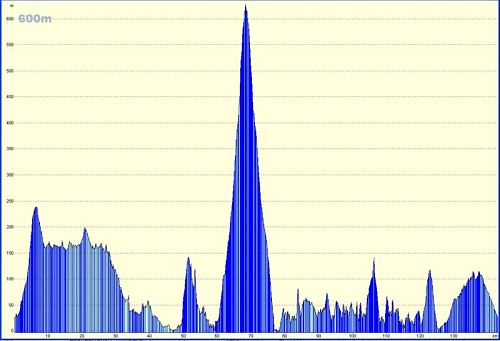
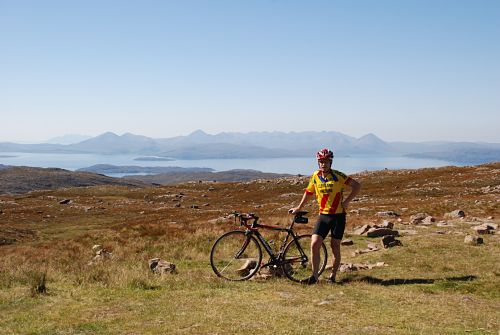
First, a little Gaelic for non-natives – Bealach means col and Mor means big. The Bealach in question is the Bealach na Ba (pass of the cattle or maybe col du coos ), and it is right in the middle of a lovely 90 mile sportive in Wester Ross. And it is big – you start beside the sea and 6 miles later you top out at 2053 feet (before promptly going all the way back down to the seaside). It is a mythical road in Scotland – the Highlands used to be full of steep bendy single track roads which were a challenge to car drivers, let alone cyclists (although British Leyland were partly to blame for that) but few remain. Those that go anywhere important (i.e. link to remote NATO bases) have, like ageing movie stars, been smoothed and flattened until their character has gone. But not the Bealach na Ba, which remains resolutely single track, occasionally poorly surfaced, and not short of bends and verticality. It’s the longest, highest road climb in the UK. And one other thing – it is unfeasibly scenic. Anyone who has never ventured to the far north west of Scotland cannot imagine the UK harbours such a mix of sea, sky, mountains, lochs and cliffs.

Bealach Mor photo 1

So in 2006, when sportives were just starting, two circular routes were created centred on the Bealach na Ba. The Bealach Mor, the big one, starts and finishes in Kinlochewe, is just over 90 miles, and totals over 3000m of ascent. The Bealach Beag (the little one) starts and finishes in Shieldaig, must be a candidate for the most glorious and quiet circular road trip to be had in Britain, but at around 50 miles is perhaps a little unsatisfying if you are making a pilgrimage from England. The maximum field for the Mor is 600 and it sells out quickly every year – entries open in December and it takes place in September. It is worth noting that 600 is a similar ball park figure to the total population living in every part of the 90 mile route. And, very importantly, the 12 miles or so over the Bealach is closed to traffic during the race. This is actually vital because the road is very narrow in places, too narrow to allow a bike to easily pass a car going the other way.

Kinlochewe is a very small village at a road junction. Oddly, there is no Loch Ewe, but the beautiful Loch Maree is just a couple of miles along the road. The start is from the village hall, on the single track Glen Torridon road and the village is overwhelmed by the number of cyclists. Not surprisingly, they get a bit fed up of people peeing in their front gardens and anyone caught doing so is rightly removed from the race. As most of the route is entirely out of sight of human habitation, it is quite unnecessary to use one of the few inhabited spots as a toilet. And while we’re on etiquette, discarding litter, especially empty fancy food tubes, doesn’t get you excluded but it should. You can register the night before or on the morning, and get supplied with your number, your dibber, and a card with the route profile and a few helpful and appropriate Gaelic phrases – “I have a puncture”, “my arse hurts”.

Immediately after starting the route turns right onto the A832, starts to climb, and keeps climbing up Glen Docherty for about 5km. The road is now wide and beautifully surfaced, it’s one of the former windy single track jobs, but the famous glorious view down to Loch Maree and Slioch remains untouched. You won’t see that unless you are unlucky enough to have an early puncture, because it’s behind you. (I’m assuming you have entered a sportive because you have some inkling of competitive spirit and a vague interest in how long it’s going to take, and that although you will enjoy the views on the way round, you won’t stop just to look at them. Later on you might pretend that is what you’re doing, but everyone will know that it’s really because you’re knackered). This climb is pretty straight, you can see it rising ahead, maybe at about 7 or 8%. Like every part of the Bealach, the wind is crucial. If you get to the top thinking you have remarkably good form despite a few pints of heavy and a wee malt last night to help you sleep, it’s a stiff westerly today.

Non-natives will already be struck by how few cars are on the roads, and this is even more obvious over the top of hill as you sweep down past Loch a’Chroisg on a road every bit as wide as, say, the A1 between Morpeth and Alnwick. There are moors and hills everywhere, but almost no signs of human occupation. The roundabout and big green A road signs at Achnasheen seem quite out of place, and the village sign is almost as long as the village itself. If you arrive here in a group (and finding a good group and sharing the work is the key to both having fun and getting a good time in sportives) you can even do that Tour de France thing of splitting round both sides of the roundabout, unless your arrival coincides with a rare car, of course. Now it’s flat or occasionally uphill across desolate moorland fringed with lumpy, stony peaks. The direction has turned through 270 degrees at the roundabout, so for the first time you get some feel for what is fitness and what is the wind. All in all, you probably want to suffer a bit here because that means the last 20 miles will be more or less downwind.

Next comes a fast descent to Ashnashellach (easily confused with Achnasheen, it’s another tiny hamlet with a big name and a railway station, or at least stop). Near here you cross a level crossing which is dangerous in the wet – you need to turn a bit to the centre of the road to cross the tracks at right angles (good advice for oblique angled level crossings everywhere). If you are really unlucky you might arrive at the same time as one of the very few trains, in which case, enjoy the scenery. It’s no distance now to Lochcarron village, a long street along the edge of the loch, where quite a few locals are out to cheer you on. The first feeding station is here and it’s a tricky decision as to whether to load up here or blast past. The last miles have been downhill or flat so you probably feel fine, but the fun is just starting.

At the far end of the village, the road suddenly rears up for the first really steep hill of the day, and the happy banter and steady progress of the riders is changed into very heavy breathing and bikes zig-zagging all over the road. It’s a couple of miles to the top then a fast and narrow descent to Loch Kishorn and the start of the Bealach itself. If the tops are clear, you get a few tantalising glimpses of the summit you have to cross and its telecom aerials – it doesn’t look very feasible at all. There is a dibbing station at the start of the climb, and then you’re off – man, mind and machine against mountain.

It’s OK to start – a steady diagonal across the hillside, amazing rocky buttresses to the right and ever widening views of the sea and Skye to the left. Eventually you turn the corner into the start of a long steep sided corrie with an apparently near vertical headwall in the distance. The road can be seen cutting a long straight diagonal up the right side of this corrie, with cyclists strung out as far as you can see. The gradient remains tolerable, probably about 10 to 15%, although you are increasingly at the mercy of a westerly wind. But then, a little hidden turn to the right and the road ramps up to around 20%. Cyclists are dismounting everywhere, and if you haven’t got granny gears on (surely not) you’ll be standing up to turn the pedals and just trying to keep going. The hillside steepens alarmingly ahead but fortunately the road relents and decides to climb the headwall by a series of hairpins. If you haven’t completely blown by here, you’ve cracked it, and can take in the view to the loch now far below, and maybe manage a smile for the photographer. There’s a flattish mile to the summit and another dib then a glorious swooping descent across boggy moorland to Applecross village and another food station. Only the real racers won’t want to pause here and stock up on flapjack, bananas and water.

Bealach Mor photo 2

Cycling looks pretty much like a sport of brute force and fitness, with not much psychology, but this point of the Bealach Mor is a big brain tester. You’re over halfway, the big climb is over, it’s a cruise from here surely? Well no, actually. For starters, it maybe only took ten minutes from the top, but all your hard work has been entirely undone – you are back at sea level. And, you are on the shore and at the mercy of the winds. The route from here twists and turns incessantly, and it is likely that some of the route will be into the wind. Only a pure westerly offers relief. Finally, the road is never flat. Innumerable small climbs and a couple of longer ones gradually sap your physical and mental reserves. On the plus side, there is the scenery (across the sea to Raasay, and on a good day, further north west to Lewis and Harris) and the solitude. You’re back on open roads (single track) but there are very few cars indeed, no villages, and a smattering of inhabited crofts outnumbered by ruins.

Bealach Mor photo 3

The field will have been shattered by the Bealach, and it is now much harder to get a group going. Nevertheless, it is worth the effort, both for physical relief and a bit of company on the long haul round the coast to Shieldaig and the final feeding station. Not many pass up the chance of a quick refuel here, a beautiful little string of whitewashed houses on the lochside.. There are only twenty miles to go, but it’s a steep little pull out of the village, and then more of the lumpy roads that characterise the second half of this route. The last and biggest little climb crests above Loch Torridon on the left, with Beinn Alliginn beyond. Straight ahead looms the upturned keel of Liathach, Scotland’s most magnificent mountain in the opinion of many. A more than welcome fast descent past the Torridon hotel leads to the lochside, and soon after, the road turns right up Glen Torridon. There is a 10 mile sign here, but what you need to cling to is that there are only five miles of gentle uphill, then it’s all downhill to the finish. Straight from the left edge of the road Liathach rises steeply in terraces of ancient sandstone interspersed with ledges of heather – the whole mountain is purple at this time of year. This bit of the road is single track to the finish, which can be a bit of a problem if you have formed a group to the end. The crest of the road is where Liathach ends and Beinn Eighe begins, a very obvious gap between the mountains. Morale rises at the 5 mile sign, which hopefully is the moment to start cranking up the speed for the final descent towards Kinlochewe and the finish line and the last dib. The organisation is super, and in no time at all you have a print-out of your times, and your ticket for as much tea, coffee, cake and stew as you could ever want. The verges around the village hall are littered with hundreds of beautiful bikes and a lot of rather more worn owners, their body language ranging from blissful to shell-shocked. Oddly, just a couple of hundred yards away , the welcoming bar of the Kinlochewe hotel is virtually empty. If ever a beer (in good weather) or a whisky (in bad) was well-earned, this must be the moment. It’s only a bit of fun, you know.

Bealach Mor photo 4

John Main – January 2011

Categories
Article

La Marmotte 2010

Dave Kirton with Rob Carter, Graeme and Stephen Hatcher.

Despite saying “I’ll never do it again” here I am on the A19 with Rob Carter heading for Liverpool airport, Geneva, then Alpe d’Huez for my second Marmotte. All thoughts of last year’s pain, suffering and difficulty replaced by an insane optimism for what is allegedly the hardest sportive in Europe. This includes 108 miles of relentless back breaking climbing over the giants of the Alps, culminating in the eight miles at 9 % up Alpe d’Huez in the blazing afternoon heat.

Rob and I are entertaining ourselves exchanging Sean Kelly and Paul Sherwen one liners such as, “We are going to be in difficulty” and “Have you packed your suitcase of courage”. Yes we are sad!!! I then inform Rob that I am going to isolate him in the mountains. The truth is the only person I will be isolating is myself as I fall away from Rob’s back wheel on the first climb like a spent booster rocket falling back to Earth!!

Anyhow on this optimistic note we hit our first and fortunately only major hitch of the holiday, My normally super reliable Peugeot 306 suddenly loses power and all the warning lights come on, we manage to roll over Clack Bank on the A19 and come to a stop on the Osmotherly slip road. I know straight away it’s serious and a quick decision is made to get the RAC to recover the car and we call upon Boro Taxis. Eventually we arrived at Liverpool Airport £150 lighter but just in time to catch our flight. PANIC OVER!

Rob and I arrive at “Hotel Chamoix” at the top of Alpe d’Huez about 8 pm on the Tuesday after the three hour drive from Geneva. This is the great little English run hotel we stayed in the year before, the tea is on the table waiting for us so we settle in for a few days of acclimatizing and steady riding before Saturday’s difficulties begin. On Thursday we are being joined by Graeme and Stephen Hatcher, we are just missing Ian Tyreman who is busy with his new “daddy duties”! And also Ian, unlike me, remembered that he said he would never do it again.

Dave (left) and Graeme practising on Alpe d'Huez
Dave (left) and Graeme practising on Alpe d’Huez

We spend a few days kicking about the top of Alpe d’Huez. On the Wednesday we take the bikes in the car down to Bourg d’ Oisans. We have a ride up the very pleasant Col d’Ornon (1371m), a nice steady eight km climb. We drop back down and then climb the first and most difficult part of the Col du Glandon. I start to suffer a bit after my earlier enthusiasm on the Ornon, so we stop at the scenic café at Le Rivier d’Allemond (1254m) over looking the mountains and the valley below.

On the Thursday we descend down Alpe d’Huez and then head about 15 km up the road to the scenic Barrage du Chambon, then return to Bourg for a café stop. Looking around there are cyclists everywhere, there must be millions of pounds worth of cycling machinery in the area. We then have a steady 1 hour 10 min ascent of the Alpe. I end up wishing I could go up in that time on Saturday.

Graeme and Ste are due to arrive today but have so much bad luck. Firstly their flight from Manchester gets delayed for two hours, next they get diverted mid flight to Lyon, then they have to catch a bus to Geneva airport. Finally at 3 am they have to sleep on the floor at Geneva airport until the car rental opens at 6.30 am. Anyhow they finally arrive looking relatively unscathed and just in time for breakfast, they even have enough energy left to go out to register and then out on the bikes for an hour before returning for a well deserved catch up sleep.

Rob went for a spin on the morning, then I go for a short spin on the afternoon. I discover that if you cycle past the Tour De France finish line on Alpe d’Huez you can in fact continue up over on a small rough road for about 4 km to a height of over 2000 m to a ski station with spectacular views over the resort. After the sightseeing we all retire for the night contemplating the big day ahead. Unlike last year at least this time I actually get to sleep, well at least until the alarm goes off at 5 am! Now its time for action!! Getting ready is like a military operation, we get loads of coffee in and try to get the food down, we are all struggling to eat at that time of the morning, all except Rob who seems to be eating for six men! Rob is anxiously eyeballing the Germans to make sure they don’t take all the bread rolls again!

Once ready with our energy supplies we roll on down Alpe d’Huez, the descent is great, if only my ride to work could be like this at half six in the morning! As we enter Bourg we break off into our start pens wishing Rob good luck as he goes into the 401-2000 pen. I, Graeme and Ste filter off into our 2001-4000 pen with the remaining 4000-8000 behind us.

The form and the running is this. Rob is hoping to finish in 7 hours after completing it in 7 hr 37 last year, and he’s calculated all the key times throughout the course. Rob has just had his first road race victory and finished in two Premier Calendar events so he should do well. Graeme is a seasoned road race big hitter with the Isle of Man race team, and about to attend his third Commonwealth Games, and he’s last year’s Isle of Man TT champion, so he should get around the 7 hour mark like Rob. Then there’s me! Well I’d like to improve on my 9 hrs 27 from last year and get into the gold cut off time of 8 hrs 49. And my palmares? Well I do have a number of second and third placings in Cleveland Wheelers’ events, not to mention my victory in the 2008 Free Wheeling competition, well that should help on the descents shouldn’t it? Then there’s Ste. Ste’s a bit of an unknown quantity. A couple of years ago he was about the same ability as me. But then he disappeared over winter and emerged as if from a chrysalis in Chapters’ racing gear and two stone lighter! Ste’s now a strong road race rider but he’s not sure how he will do here. I think he will be around the 8 hr mark.

As the time ticks away the 0-400 group are all out at 7 am, Rob gets away at about 7.10 am in his group, then me, Graeme and Ste squeeze out over the line at exactly 7.30 am. My plan is to unashamedly grab onto every wheel, tree and branch that I can to claw myself around and gain as much time as possible! I latch myself onto Ste and Graeme’s wheels to get a free ride, as Graeme uses his vast racing experience to cut a swathe through the riders. We quickly complete the first 6 km to the climb up the side of the dam at the base of the Glandon, I thank Graeme for the lift and as he accelerates off then Ste and I settle into our own pace. We climb up the first difficult 6 km of the Glandon. I’m not riding as cautiously as last year but just trying to keep within myself. The road plateaus off at le Rivier d’Allamond and I need to take a natural break. I tell Ste to press on as we had agreed earlier that we wouldn’t waste time waiting for each other. I have a quick stop then carry on up the next section. I target various riders who are just a little faster than me and keep latching on, this system seems to work well for me and I arrive at the top of the Glandon (1924m) in 1hr 53m, 15 minutes ahead of last year and feeling good.

Dave looking fresh on the Glandon

I stop at the feed station to fill my bottles then press on down the descent. I pass many riders until I eventually settle into a good descending group. On the valley road to the Telegraphe I get into a low gear and spin for a while. The road is heavy and slightly uphill for a few km, Last year I stopped at this point as I thought my back brake was stuck on. I also spend the next 10 km trying to chew through a ‘Go bar’ I’m finding it difficult to get enough food down. I’m in a good group all along this road, even though I sit in all the way, the heavy road still starts to wear me down by the time I reach St Michael de Maurienne. I make up two bottles of energy drink at the feed station, take my old base layer off, throw it away and after a bar and a gel am back on my way in less than five minutes.

I start my ascent of the Telegraphe, this warm up climb for the Galibier isn’t as easy as it should be. It’s 12 km or one hour’s worth of Clay Bank! I climb up it nicely and arrive at the top (1570m) just over the hour after being stopped by road works and a traffic jam 1 km from the top. At the next feed station there are dozens of riders wrestling over the few water taps provided. Once refilled again I set of on the short descent to Valloire using the time to get a bar and gel down. After my terrible time on the Galibier last year I start the climb extremely steady to try and ride myself into it. Just outside Valloire there’s the 17 km sign for the top, the countdown begins! I reach the water stop at the 10 km to go sign and my plan seems to be working as I begin to feel good. Many riders are stopping to put their capes on as the rain starts to come down, I continue straight on as this weather suits me just fine. It feels like the normal weather over Castleton to me! I wish it could stay this temperature all the way round.

As I climb through the hairpins over the top section of the Galibier the kilometre signs tick away. It’s very difficult going, but I’m feeling okay and manage to keep 6-7mph all the way. I take time to enjoy the climb looking at the scenery and long line of riders stretching all the way down the valley below. This climb is so dramatic as I count down the final few steep kilometres, the huge backdrop of mountains rise above me, there is snow at the sides of the road, rivers of water and gravel spilling across the road and the dark clouds rumbling with thunder above me.

It’s fantastic!

I roll over the top of the mighty Galibier (2642m) in 6hrs 10m, still well ahead of last year. As I descend down to the Lautaret I do some quick calculations, I’ve got 2hrs 40m to make it down to Bourg and back up Alpe d’Huez if I’m to get inside the gold time. “It’s going be tight!”

I reckon at this point Rob should be well on with his climb up Alpe d’Huez, and Graeme should be off the descent of the Lautaret, Ste’s maybe ten minutes ahead of me. I settle into a good group on the descent from the Lautaret back to Bourg, we have to pass through several tunnels on the way. These are dangerous as the road surfaces are wet inside and you can’t see much. As we enter the first tunnel the lights are off and we’re plunged in to complete darkness, lots of riders are shouting “Woo Woo!” I whip off my glasses and point the bike to the light at the end of the tunnel. I emerged safely, but it wasn’t pleasant.

I complete the descent of the Lautaret okay including the several small hills towards the end. I even manage a few turns on the front of the group which has swollen to about 20 riders. As we do the last few kilometres into Bourg the pace steadies off as all the riders prepare themselves for the final big push up Alpe d’Huez.

After stopping at the feed station at the bottom I start my ascent of the Alpe. This is by far the hardest part of the ride. 35 degrees C and a 10% uphill for the first few kilometres. Last year I climbed it well in 1hr 20, I need to climb it in 1hr 30 this time to get in the gold time, so I should be okay, but then disaster strikes. At 4 km into the climb at La Garde I slow down to grab water at the watering station, and then scream out as the back of my legs go in to full cramp. Lots of people are looking as I straddle the bike unable to move! After a short while it eases off and I manage to cautiously pedal off. But I continue cramping up again every kilometre. This is now serious! I can cope with being out of energy as you can always crawl along at 5 mph, but cramp is a complete job stopper. The minutes fly by as I keep having to stop and stretch my legs.

I look up at 5 km to go and I can see the top, I need to be up there now but just can’t do it. As the gold time comes and goes my legs finally settle down and I manage the last few kilometres without stopping. I felt good at the bottom of the Alpe, now 1 hr 40 later I crawl over the finish line absolutely exhausted and in pain. The good news is that I’m 29 minutes faster than last year with a time of 8 hrs 58 mins, the bad news is I’m just 8 mins outside the gold time.

I decide to walk my bike back to the hotel, I clamber up to the fourth floor! Ste’s laid out on the bed, he’s completed it 8 hrs 44. Unfortunately for Ste his gold time is set at 8.29 as he only just fell in to the age category below at the time when he put his entry in. Rob and Graeme return to the room after finishing and getting showered some time ago. Rob did a fantastic 7 hrs 04 but is disappointed to be over the 7 hrs. Graeme has finished in 7 hrs 16, I can’t tell whether he’s pleased or not as he doesn’t give much away! But it doesn’t matter anyway as he suddenly produces a box of beers from a bag! Good lad.

I greedily neck a few beers to ease the aches and pains as we all contemplate the ride. Although we all did very well we are all sitting around looking rather disappointed, why is it I wonder that we set such targets for ourselves? Then when we still do well but just fall short of the target we feel so disappointed? We should be just glad to get round in good times. Even my time is within the top 25%.

After some recovery time we go out for a walk to cheer ourselves up and watch the stragglers coming in. We stand on one of the last hairpins where there’s a steady flow of riders still coming up. I really admire these people who have taken 12 and 13 hours to complete it, some of them look much fresher than I did at the finish, and maybe they have just had a nice steady day out with just the aim of completion. Maybe not a bad idea for next time!

At the moment I can’t see a next time for the Marmotte. I would recommend it to anyone who loves to ride in the high mountains, but it is extremely difficult and if I’m to expend this kind of effort again then I’d like to do something different and perhaps a little easier, maybe the Etape or a Grand Fondo in Italy. Or maybe a nice ride to Sandsend tea shop. Now that would be easier!

Dave Kirton – December 2010

Categories
Article

Training for the Tour de France

Training for the Tour de France 8:17. A personal best time. Not that anyone is celebrating you understand. There’s no one here with flowers, champagne, interestingly coloured jersey, cute cuddly toy lion with optional St. Bernard or even a well done, but nevertheless it remains my personal best time. Eight minutes and seventeen seconds. That’s all it took to acquire one weeks worth of shopping in the supermarket. With a little more training and by arriving at the supermarket earlier to avoid the post school run queue I reckon I could shave off another minute and a half. Why am I doing this? I’m training for the Tour de France.

Well, I’m not cycling around the supermarket obviously. Of course, being female I’d have to do the Tour de l’Aude instead, which is only a week long and certainly doesn’t require me to sprint around supermarkets as though my hair is on fire, because they never broadcast a second of coverage in the UK anyway. This despite the fact that Emma Pooley seems to win it regularly. Say what you like about the woeful inadequacies of the nation’s football team, we do happen to be rather good at cycling in this country, and you’d think that with all that lycra the nations papers would be plastering pictures of cyclists all over the place in a bid to raise sales. Er, where was I?

Oh yes. Standing outside a supermarket, out of breath.

I’m here practising my speed shopping so that I can maximise my Tour de France viewing. Every year I seem to miss vital parts of the race through having to do mundane things like shopping, cleaning, putting the washing out and well, living, I suppose. So this year I am in training to get any essential jobs out of the way before the coverage starts.

Do I have nothing better to do? This is something better to do! Who wouldn’t want to spend six hours a day for three weeks watching various internet tickers, reading Twitter feeds, watching Eurosport and listening to Sean Kelly, Dave Harmon and Carlton Kirby as they commentate on the racing? Well alright, so just me then. Nevertheless, I shall be doing it and I shall be doing it uninterrupted, particularly by supermarket shopping.

I could get my shopping delivered, which would solve the problem of actually fetching it. The few times I have done this I have been aghast at the amount of carrier bags required to transport items from van to house. I swear individual tins get individual carrier bags and customer service seems to be an ideal unheard of these days. Given that I live around the corner from a supermarket it just seems simpler to go and get it myself.

Other problems are coming to mind now. Do I disconnect the phone for the duration of commentary? How do I answer the door without missing that vital sprint finish? Should I rearrange the house layout so that the kettle is next to my computer? Perhaps I could just move everything into the bathroom. Well, maybe that’s going too far. I’ll keep working on my shopping instead.

Alice Wood – June 2010